Melamine Kitchen Cabinets: Pros, Cons & Cost
Melamine is the most widely used cabinet finish you have never heard named correctly. Here is what the published standards say about how these panels are made, how they hold up to scratches, water and time, what they actually cost — and how to check a melamine quote before you sign it.
Melamine cabinets are made from thermally fused laminate (TFL) panels — resin-impregnated decorative paper fused directly onto a particleboard or MDF core. They earn their place on four parameters: excellent scratch and wear resistance, a wipe-clean surface, consistent wood-look or solid-color finishes across large orders, and a cost position at the entry end of finished cabinet surfaces. They lose on one parameter that matters long-term: repairability. A chipped edge or a water-swollen core cannot be sanded and refinished like wood.
Melamine suits: budget-driven kitchens, rentals and pre-sale refreshes, multi-unit and hospitality projects that need identical finishes across dozens of rooms, and modern flat-panel designs. It is a poor fit for: anyone planning to repaint later, wet-zone cabinets without upgraded edge and sink-base detailing, and buyers who want the option to repair rather than replace a damaged door.
What a Melamine Cabinet Actually Is
The word "melamine" gets used loosely. In cabinet specifications, the precise term is thermally fused laminate (TFL) — the Composite Panel Association (CPA), the North American trade body for these panels, describes TFL as the surface formerly known as melamine. The panel is made in one step: a decorative paper, generally weighing 60 to 130 grams per square meter, is saturated with melamine resin and fused directly to a substrate under heat and pressure. The heat activates the resin, which cross-links with the board and becomes the panel's finished surface — no glue line, no separate laminate sheet, no painting line.
Two details in that process explain most of what follows in this article. First, the surface is paper-thin by design, which is why it cannot be sanded back and refinished. Second, the CPA names particleboard and MDF as the ideal substrates for TFL — which means a "melamine cabinet" is really a particleboard or MDF cabinet wearing a fused decorative skin. The core material carries the structure, the screws and the moisture behavior; the melamine face carries the color, texture and scratch resistance. If you want the substrate side of the story, our guide to MDF cabinets covers how that board behaves on its own.
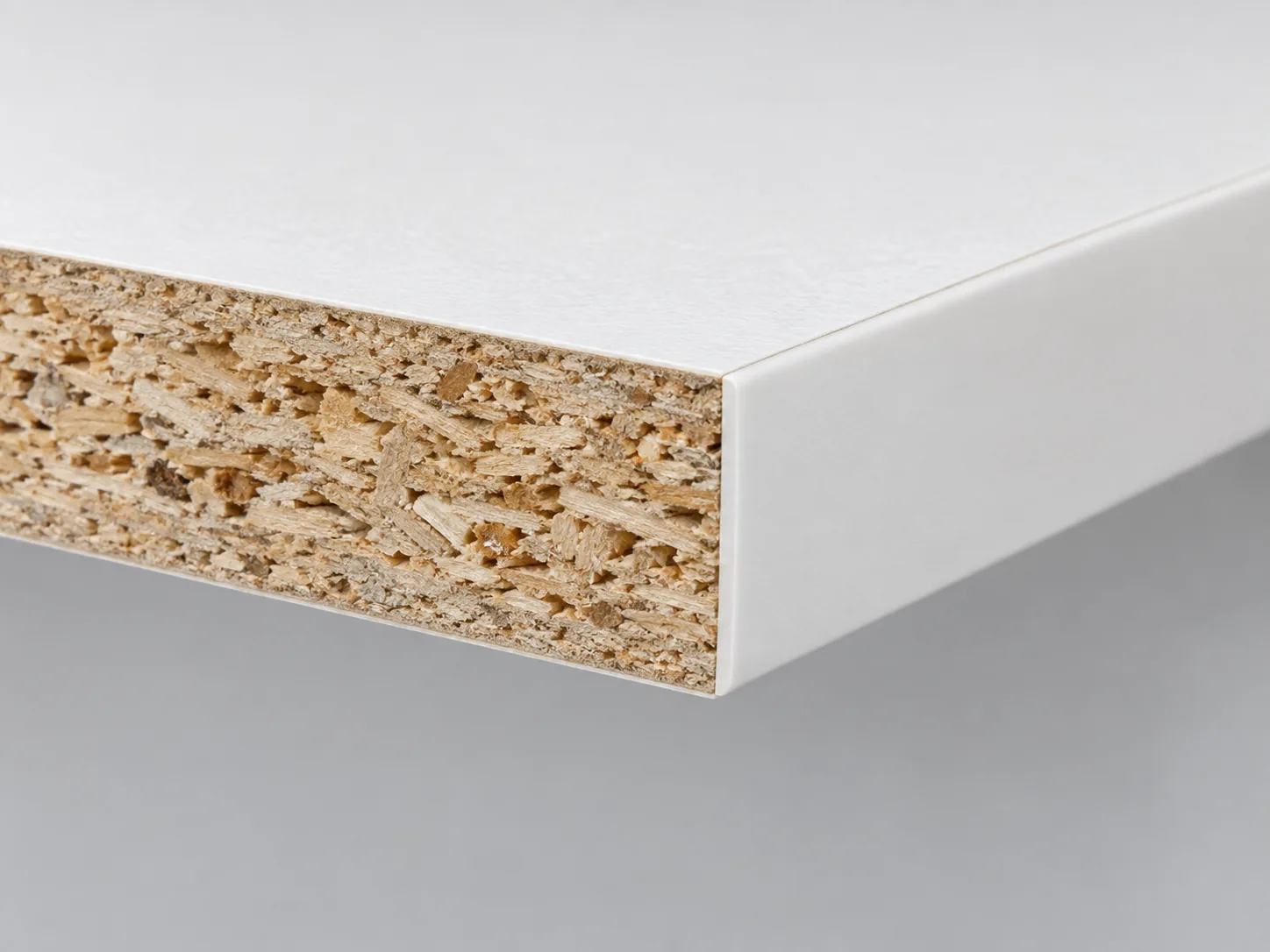
Because the texture is embossed by steel press plates during the same press cycle, the surface can carry convincing wood grain, stone or matte solid finishes — and the same décor prints can be shared with high-pressure laminate (HPL) production, so a project can match TFL cabinet boxes to HPL countertops or doors without color drift. The finish you see in a showroom is exactly the finish the press plate puts on every panel in the run, which is why melamine dominates multi-unit work where fifty kitchens must look identical.
Melamine vs. the Other Finishes, Parameter by Parameter
Buyers usually meet melamine as one option in a finish lineup. The table below compares it with the finishes it is most often weighed against, using parameters you can verify on a spec sheet rather than showroom adjectives. Comparative judgments here are qualitative, based on how each surface is manufactured, not on a single lab test.
| Parameter | Melamine (TFL) | Painted / lacquered | Wood veneer |
|---|---|---|---|
| What the surface is | Resin-fused décor paper (60–130 g/m²), pressed onto the core in one cycle | Sprayed coating system built up in layers, usually over MDF | Sliced real wood, pressed onto a plywood or MDF core |
| Scratch & wear resistance | Excellent — the CPA rates TFL's scratch and wear resistance as excellent, which is why it is standard in office furniture and store fixtures | Moderate; can chip at corners, but spot touch-up is possible | Softest of the three; dents and scratches show, though they can be repaired |
| Water behavior | Surface wipes clean; the risk is at edges and seams, where water can reach the core and swell it irreversibly | Coating protects until breached; damaged lacquer admits water to the MDF below | Veneer can stain or lift at joints if repeatedly wet |
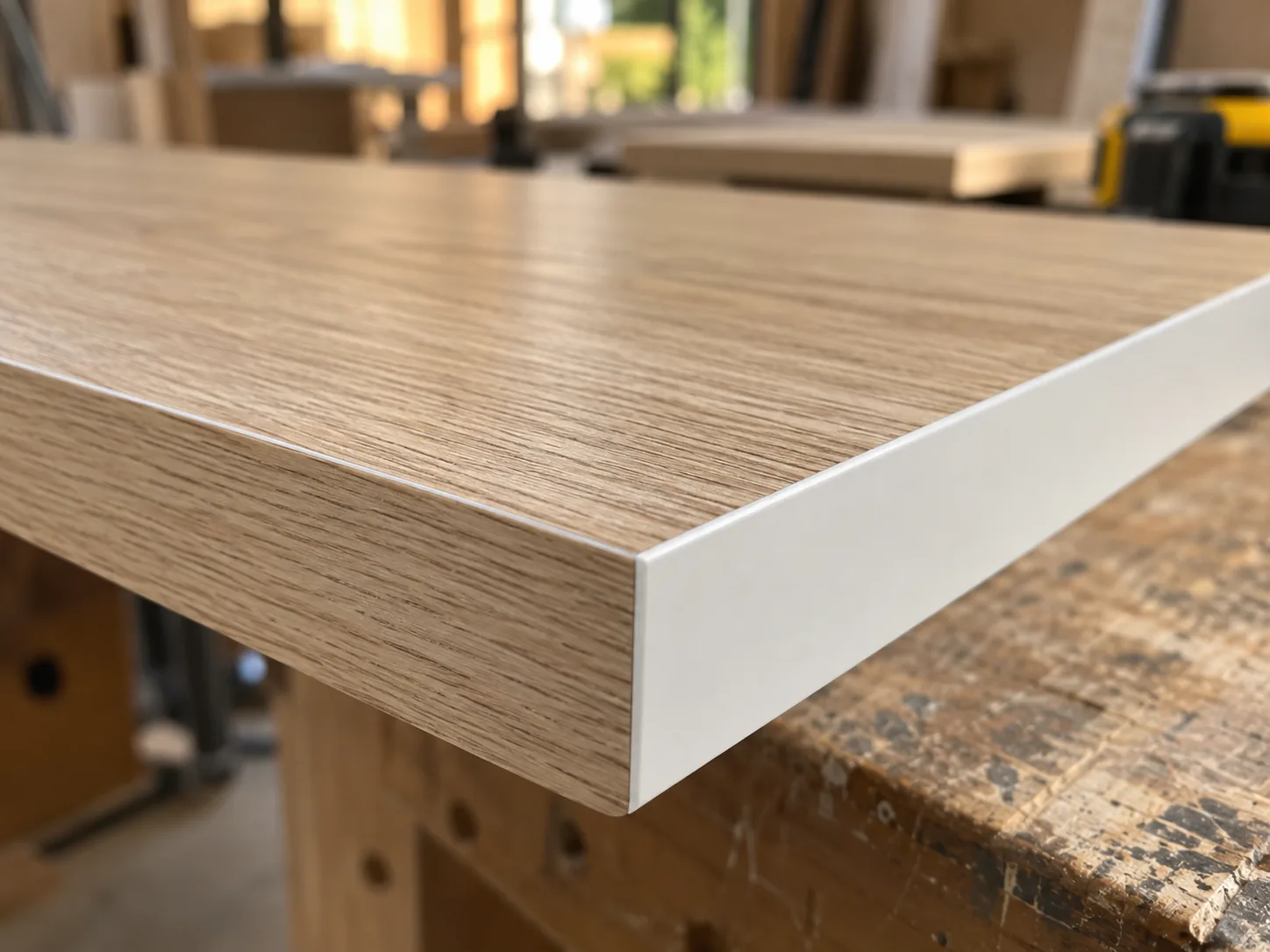
| Edges | Requires edge banding; machined edges can chip if blade or feed rate is wrong | Seamless — edges and profiles are painted with the face | Can be profiled; edges usually show a solid-wood or veneer lipping |
| Refinishing later | No — the fused paper surface cannot be sanded or repainted reliably | Yes; can be repainted by a competent shop | Yes, within the limits of veneer thickness |
| U.S. emission limit (TSCA Title VI / CARB Phase 2) | Set by the core: 0.09 ppm for particleboard, 0.11 ppm for MDF — the melamine face does not change the category | 0.11 ppm (MDF core) | 0.05 ppm (hardwood plywood core) or 0.11 ppm (MDF core) |
| Cost position | Entry end of the finished-surface price range — the surface is applied in the board press, with no separate finishing line | Mid to high — finishing labor and spray-booth time dominate | High — real-wood material plus veneer pressing and finishing |
Sources: Composite Panel Association TFL overview (definition, décor paper weight, substrates, scratch/wear rating, edge treatment); U.S. EPA TSCA Title VI emission limits. Emission limits are legal floors by board category, not quality grades. If your comparison is between laminate-type surfaces and real timber construction rather than finishes, our laminate vs. solid wood comparison covers that decision.
The Honest Pros and Cons
Where melamine wins
- Scratch and wear resistance. The CPA rates TFL panels as excellent on both counts — the reason the same material covers office desks, store fixtures and closet systems that take daily abuse.
- Wipe-clean maintenance. The cross-linked resin face is non-porous; cooking grease and fingerprints come off with a damp cloth, with no polishing or oiling schedule.
- Finish consistency at scale. Every panel in a production run carries the same press-plate texture and color. For a 40-unit apartment block or a hotel floor, that consistency is the point.
- Price position. The decorative surface costs one press cycle, not a finishing department — which is why melamine lines typically anchor the entry tier of a cabinet range.
- Design range. Wood grains, stones and matte solids from the same platform, with exact-match HPL available for countertops and high-wear doors.
Where melamine loses
- No refinishing path. When the look dates or the surface is damaged, you replace the door — you cannot sand and repaint a fused paper surface the way you can repaint lacquer.
- Chipping at edges. The fused surface is brittle at machined edges. A dull saw blade, wrong feed rate or rough handling chips it, and chips are difficult to repair invisibly.
- Water through the edges. The face shrugs off splashes; the core does not. Water that enters at a failed edge band, an unsealed hinge bore or the sink-base floor swells particleboard or MDF permanently.
- Weight on MDF cores. MDF-core melamine doors and panels are heavy; wall cabinets need proper fixings into studs or solid blocking, not drywall anchors.
- The budget reputation. Because melamine anchors the entry tier, some buyers read it as cheap regardless of specification — worth knowing if resale perception matters to you.
What Melamine Cabinets Cost — and What Moves the Number
At the panel level, melamine board is a commodity. In a September 2026 sample, one U.S. building-materials retailer (Ring's End) listed a 3/4″ 4×8 white melamine panel at $61.50. Treat that as a single-retailer online list snapshot, not a market average — it tells you the order of magnitude of the raw material, nothing more.
The finished-cabinet quote is where the real differences live, and panel price is only one line. When two melamine kitchen quotes come in far apart, the gap is almost always in these items:
| Quote line | What to check | Why it moves the price |
|---|---|---|
| Core material & thickness | Particleboard or MDF; 16mm vs 18mm panels | Thicker, denser cores cost more and hold hardware longer |
| Emission compliance | CARB Phase 2 / TSCA Title VI certification named on the quote | Certified board costs more than uncertified; it is also a legal floor for U.S. sale |
| Edge banding | Thickness (1mm vs 2mm), ABS vs PVC, laser or hot-air edgebanding vs glue-pot | The edge is where melamine cabinets fail first — better banding is the cheapest durability upgrade on the sheet |
| Hardware | Hinge and slide brand and series (e.g., Blum, Hettich), soft-close or not | Hardware is a larger share of a melamine kitchen's cost than of a premium kitchen's |
| Sink base & wet zones | Upgraded core, sealed edges, drip tray or aluminum liner | A small line item that decides whether the sink base survives its first leak |
| Packaging & freight | Flat-pack vs assembled, corner protection, container loading plan | For import orders, protection and freight routinely exceed the panel cost difference between suppliers |
The practical takeaway: compare melamine quotes line by line on specification, not on the word "melamine." A quote that states core, thickness, edge banding, hardware brand and emission compliance can be checked on delivery; a one-line "melamine kitchen" quote cannot.
Who Melamine Cabinets Suit — and Who Should Look Elsewhere
| Your situation | Does melamine fit? | Specification notes |
|---|---|---|
| Homeowner, budget-driven kitchen refresh | Yes — the core use case | Spend the savings on the sink-base upgrade, 2mm edge banding and named-brand hardware; that combination outlasts the finish |
| Rental property or pre-sale renovation | Yes | Neutral matte colors photograph well and wipe clean between tenants; avoid the cheapest core — tenant damage finds it first |
| Contractor / developer, multi-unit order | Yes — this is melamine's home ground | Lock the décor print and press-plate texture in the contract so reorders match; confirm CARB/TSCA documentation for U.S. projects |
| Importer / dealer building a product line | Yes, as the entry tier | Pair a melamine line with a lacquer or veneer tier so the catalog covers two price points without hiding the construction difference |
| Homeowner who may repaint in 5–10 years | No | Choose a painted/lacquered finish that can be refinished; melamine doors are replaced, not repainted |
| Humid or coastal climate, indoor kitchen | With conditions | Melamine is workable, but the wet-zone detailing (sealed edges, upgraded sink base) stops being optional; outdoor kitchens need different construction entirely |
Melamine also pairs naturally with flat-panel door design — the finish comes off the press perfectly flat, and simple slab fronts show off the wood-grain textures best. Our flat-panel cabinet guide covers that style direction in detail.
Comparing Melamine Quotes Right Now?
Send us your floor plan or the quote you already have. We will return a specification-locked quote — core material, panel thickness, edge banding, hardware brand and emission compliance stated line by line — so you can compare offers on equal terms.
How George Group Builds Melamine Cabinets — and How You Can Verify It
George Group's melamine cabinet construction uses 18mm CARB Phase 2 / EPA TSCA Title VI compliant panels with machine-applied edge banding on all exposed edges, soft-close hardware from Blum or Hettich, and FSC-certified material available on request. Dimensional tolerance on shop drawings is ±1mm, cabinets carry a 10-year limited structural warranty, and production typically runs 35–45 days after drawings are approved. Sink bases can be specified with upgraded moisture-resistant cores and sealed edges — the two positions we recommend treating as non-negotiable on any melamine order. The full construction range is on our kitchen cabinet category page.
These are the same specifications published on our product pages, and they are checkable on delivery. Whether you order from us or anyone else, this is the inspection that keeps a melamine supplier honest:
- Read the panel label or certificate. TSCA Title VI compliance labeling is required on composite wood sold in the U.S.; ask which board category (particleboard or MDF) the certificate covers and whose name is on it.
- Run a fingernail along the edge banding. A well-applied edge is flush with the face, with no glue line you can catch a nail on. Gaps at corners are where water enters first.
- Look inside the sink base first. Check the floor panel's core at the plumbing cutout — that raw edge shows the actual board you bought, and whether the wet-zone upgrade in the quote is actually in the cabinet.
- Check a machined edge against the light. Clean cuts with no chipped flakes along the melamine face mean sharp tooling and correct feed rate; edge chips on day one spread with use.
- Measure panel thickness. Confirm 18mm (or whatever was quoted) rather than a thinner substituted board — calipers do not negotiate.
- Cycle every hinge and drawer. Soft-close hardware from the named brand should be present on every door and drawer, not just the showroom pair.
Methodology and Sources
This article describes melamine (TFL) panels using the Composite Panel Association's published technical overview — definition, décor paper weight, substrate guidance, scratch and wear rating, edge treatment requirements and application range — plus U.S. EPA TSCA Title VI / CARB Phase 2 emission limits, which apply to the panel's core material category. The CPA published a voluntary TFL panel standard (CPA 5-25) in May 2025 setting requirements and test methods for these panels. Comparative judgments between finishes are qualitative, based on how each surface is manufactured, not on laboratory testing. The panel price is a single U.S. retailer's online list price observed in September 2026 and is not a market average. George Group construction specifications reflect our published product-page figures and are verifiable on delivery.
- Composite Panel Association — Thermally Fused Laminates (TFL) (definition, décor paper 60–130 g/m², substrates, scratch/wear rating, edge treatment, applications)
- Composite Panel Association — CPA 5-25 Thermally Fused Laminate (TFL) Panel Standard (May 2025, voluntary standard)
- U.S. EPA — Frequent Questions for Consumers about the Formaldehyde Standards for Composite Wood Products Act (TSCA Title VI limits: 0.05 ppm hardwood plywood, 0.09 ppm particleboard, 0.11 ppm MDF, 0.13 ppm thin MDF)
- Ring's End — 3/4 in. White Melamine Panel, 4 ft. × 8 ft. (online list price $61.50, observed September 2026; single-retailer sample, not a market average)
FAQ
Planning a Kitchen, Villa or Multi-Unit Order?
George Group builds custom melamine cabinets to verified specifications — 18mm CARB Phase 2 / TSCA Title VI compliant panels, Blum/Hettich hardware, machine-applied edge banding — with shop drawings you approve before production starts.