Buying furniture from China is not one decision — it is three. You can buy through a B2B platform, hire an agent or fly to Foshan yourself, or contract a factory direct. All three work. They fail in different places: the sofa that felt firm in the showroom sample arrives with softer foam, the "solid wood" frame turns out to be mixed scrap timber once the upholstery comes off, and the freight bill — charged by volume, not weight — lands at double the number you budgeted.
This guide is the process we run for overseas buyers from our own furniture factory in Foshan: how the three paths compare, where furniture orders actually go wrong, and how to lock what you approved into what gets loaded. Every step is transparent — including the inspection records we hand to our own clients.
This is for: importers, wholesalers, developers, contractors, designers, and homeowners furnishing a house, villa, hotel, or multi-unit project.
Not for: one-off retail purchases — if you need a single sofa for your living room, international freight and customs clearance will cost more than buying locally.
| Path | How It Works | Who It Fits Best |
|---|---|---|
| B2B platforms (Alibaba, Made-in-China) | Browse listings, message sellers, arrange your own inspection and shipping | Small trial orders; buyers who can verify suppliers themselves |
| Sourcing agent or a Foshan market trip | An agent — or you — walks the markets, mixes suppliers, consolidates a container | Buyers who want to see and sit on pieces before committing; mixed one-off projects |
| Factory direct | Specs locked in a contract with one factory; production, QC, and loading under one roof | Volume orders, whole-house and hospitality projects, repeat importers |
Foshan, in Guangdong province, ships furniture to every continent — the factories, the showrooms, and the logistics are all here. What has never been evenly distributed is information: what a sofa should cost, what is actually inside it, and what happens between your deposit and your container. That gap is where furniture orders go wrong, and it is what this guide is written to close.
Why Buyers Source Furniture from China in the First Place
The short answer is structural: the world's furniture supply chain is concentrated in one corner of Guangdong province, and that concentration makes furniture cheaper, faster to produce, and better specified — not the other way around.
- Price. Foshan's pan-home-furnishing industry generates more than RMB 1 trillion in industrial output and exports to over 100 countries and regions, according to the Guangdong provincial government. When the fabric market, the foam supplier, the hardware wholesaler, and the frame workshop all sit inside the same cluster, there is no layered logistics markup between them — the price you are quoted is materials plus labor plus factory margin, not a tour through three countries of middlemen.
- Materials. The cluster is not only factories — it is the materials market itself. Fabric, foam, hardware, and stone trade in bulk within the same district, so factories buy from spot stock instead of waiting on import lead times. "Good materials" is less about promises and more about access: the kiln-dried hardwood, high-density foam, and branded hardware that count as upgrades elsewhere are standard stock here.
- Speed. Sampling, revision, production, and export documentation all happen inside one supply chain — no overseas back-and-forth for a fabric change or a new leg design. Actual lead times still depend on the process and material requirements of your specific order (more on that below), but the starting point is weeks closer than anywhere else.
- Design bundled into the order. Chinese export factories routinely include design work — shop drawings, 3D renderings, material boards — because their design teams sit next to the production line. Our version of this is further down the page: free whole-house 3D design, with the design deposit deductible from your order.
- Export experience at national scale. China Customs reported US$67.9 billion in exports of furniture and parts in 2024, up 5.8% from 2023, and Xinhua, citing the China National Furniture Association, describes China as the world's largest furniture manufacturer and exporter. At that scale, documentation, consolidation, and shipping are routine — your supplier has done them thousands of times.
- Policy support. Under RCEP, in force since 2022, more than 90% of goods trade within the region will eventually be tariff-free, according to China's Ministry of Commerce — a direct tariff advantage for buyers in ASEAN, Japan, Korea, Australia, and New Zealand. China's export tax rebate policy refunds up to 13% of VAT on exported goods depending on the product code, which is part of why Chinese export pricing stays competitive. For your specific product and destination, confirm the applicable rates with your supplier before you sign.
So the advantages are real. They are also available to every factory in the cluster — including the ones that will quote you a beautiful sofa and ship you a scrap-wood frame. China's supply chain makes great furniture at a great price possible; it does not make it automatic. The rest of this page is about the path where the buyer holds the most leverage — factory direct, with the spec written down before the deposit — and about making "possible" actually happen.
Where Furniture Orders Actually Go Wrong
Cabinetry fails in millimeters. Furniture fails in cubic meters, foam densities, and things nobody can see once the fabric is on. We run QC on whole-house projects delivered to five countries, and the furniture records always tell the same five stories. Learn them once, and you will spot the risk in any quote — including ours:
- Freight is charged by volume, not weight. A sofa is mostly air. Carriers bill by cubic meter, so lazy packing — no knocked-down frames, no nested cartons — can push the shipping cost of a piece close to its factory price. Compare packing dimensions and CBM per item, not just unit prices.
- The sample is not the production run. A 35D foam and a 25D foam feel nearly identical in a showroom; six months of daily use tells them apart. Fabric re-orders come from different dye lots. If the approved sample is not kept sealed as the production reference, "same as sample" is an opinion, not a standard.
- Platform photos are not evidence. Many listings show renderings, or photos bought from the same studios. The factory that made the sofa in the picture may not be the one quoting you — and a beautiful photo says nothing about what is inside the frame.
- Frame material is invisible — on purpose. Kiln-dried hardwood holds joints tight for years; mixed scrap wood sags, cracks, and squeaks. Once the piece is upholstered, nobody can tell the difference, which is exactly why it must be written into the contract instead of assumed.
- Flammability compliance is market-specific. US-bound upholstery commonly references CAL TB117; the UK references BS 5852. Requirements like these can be arranged per order — but only if they are confirmed in writing before the deposit, not discovered at customs.
None of these are reasons to avoid buying furniture from China. They are the reasons the process below exists.
How George Group Runs a Furniture Order
The industry advantages above are shared by every serious exporter in the cluster. What you are really choosing between suppliers is what they add on top — and which of your problems those additions solve. Here is what we add:
Own factory, not a catalog reseller. Sofas, beds, dining sets, and outdoor furniture come from our own factory in Foshan. You pick styles on our online selection platform — or send reference photos of what you want — and we quote every option to the same written specification, so comparing prices means comparing like for like.
How that works in practice: you shortlist the styles you like on the platform, and we price every option to one written spec — same frame standard, same foam density, same fabric grade — so a lower number always reflects a real choice, not a hidden downgrade. If none of the listed styles is what you are after, send reference photos; we match and quote them the same way, so the conversation stays on one spec sheet instead of ten chat threads.
For whole-house orders, we produce free 3D renderings first: your furniture coordinated with the cabinets, doors, and finishes in one palette, revised until you sign off (the design deposit is deductible from your order). Production starts only after your approval. And if your project goes beyond furniture into a full category spread — cabinets, doors, windows, tile, sanitary ware, lighting — that is exactly the one-stop building materials package we run under a single contract.
One project manager, one order file. Every stage — drawings, samples, production milestones, QC, loading — closes with evidence you can open, so you always know which step your order is on, and what comes next. You never have to ask "so what's happening with my order?"
Furniture can also share one consolidated container with your cabinetry and other categories, so you don't need container-scale volume in furniture alone. The loading plan — what goes in, at what CBM — is worked out with your quote, not after it.
What Pre-Shipment QC Checks on Furniture
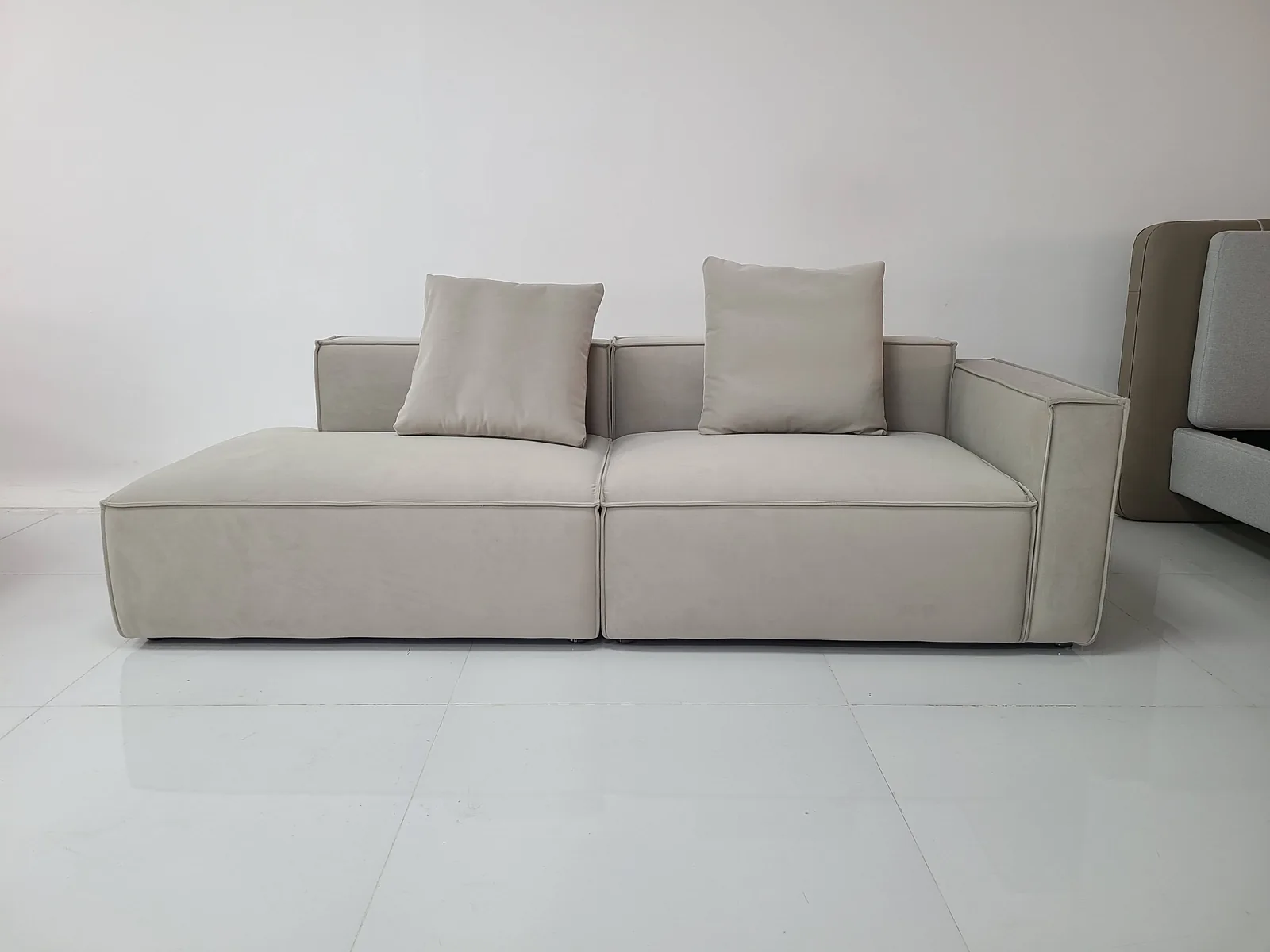
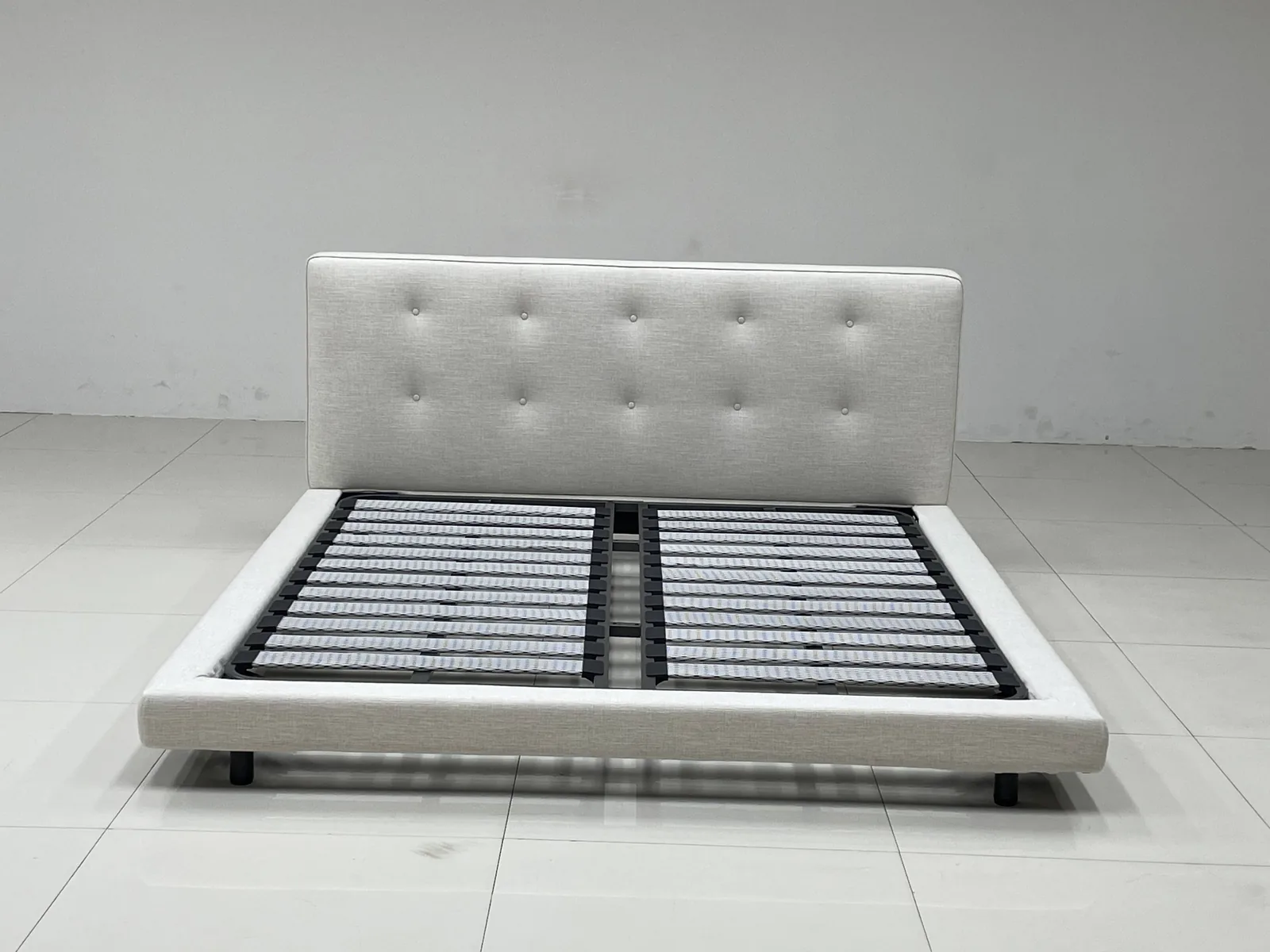
Every order gets a live online QC report before anything is loaded: dated photos, checked item by item against the PI, the approved drawings, and your sealed samples. "Inspection" only means something if you know what one record contains — this is what our QC team checks on furniture:
| Checkpoint | What We Check |
|---|---|
| Frame & joinery | Kiln-dried hardwood frame vs spec, corner blocks and joint tightness, no squeak or sway under load |
| Foam & filling | Seat and back foam density against the approved spec, rebound test, cushion fill evenness |
| Upholstery & stitching | Seam straightness, stitch density, pattern alignment at joints, zipper and velcro finish |
| Function tests | Recline mechanisms, drawers, doors, folding and moving parts — cycled repeatedly, not just looked at |
| Color & material match | Fabric and leather checked against approved swatches under daylight lamp, dye lot verified |
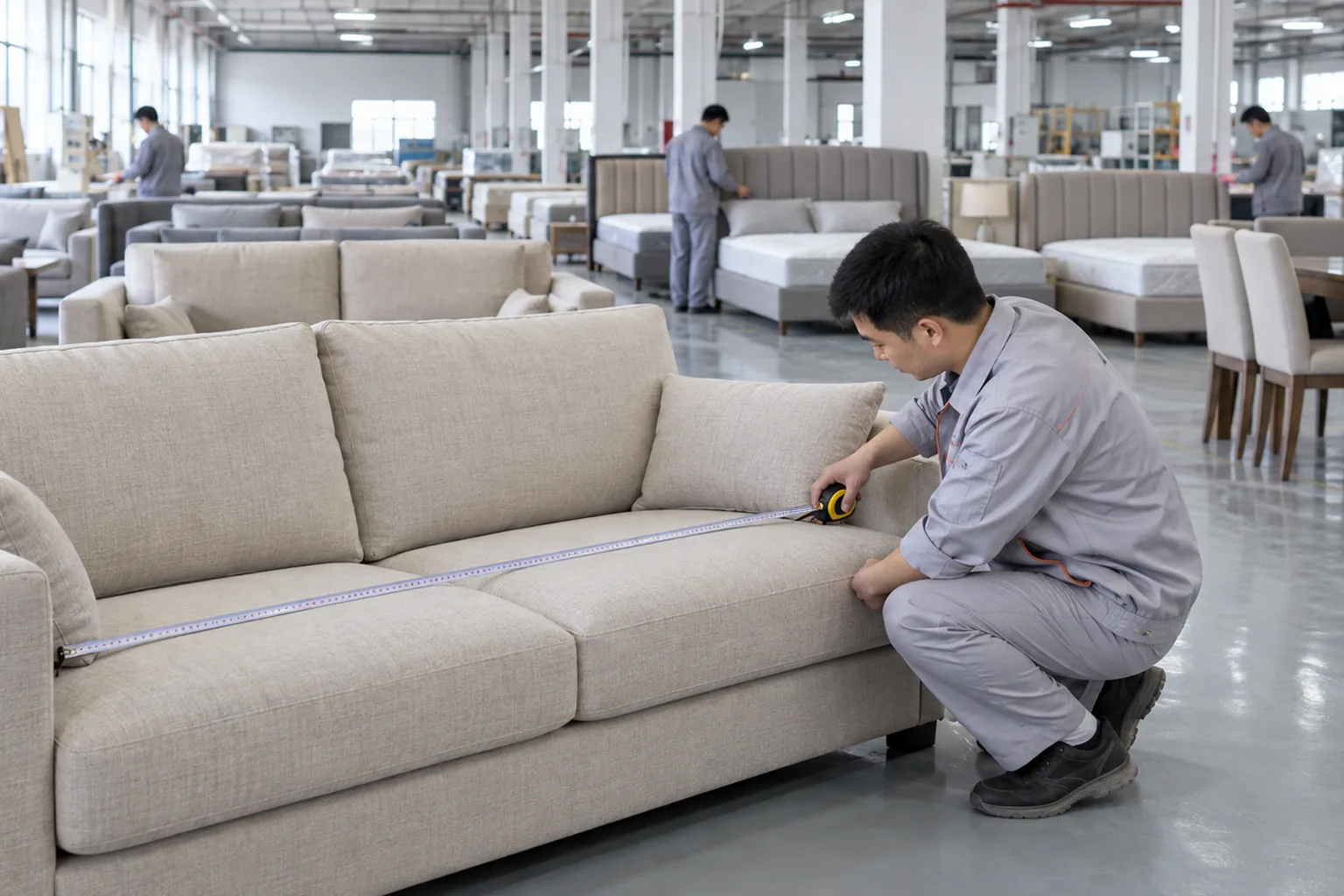
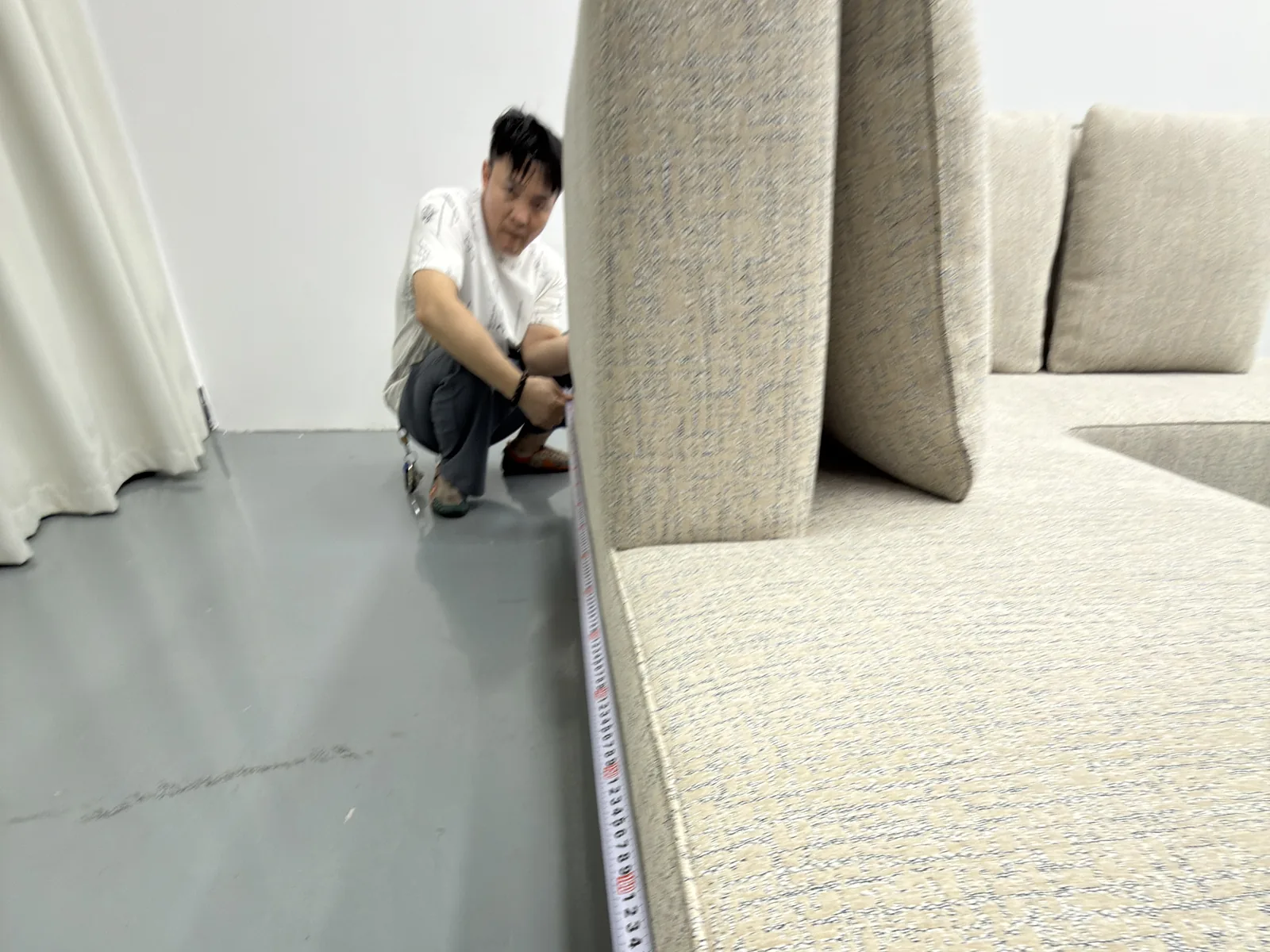
| Dimensions | Measured against the approved drawings, taped and photographed for the report |
| Export packing | Corner protection, moisture wrap, carton spec and marking for export handling |
Recent project files (client details removed): a villa project in Dubai — 75 inspection records, 13 of them furniture; a whole-house project in Texas, USA — 121 records across categories, including the furniture package; a villa project in Ghana — 24 records, furniture included. Anything that fails is photographed, flagged, and corrected before loading — the failure and the fix both go into the report. That is the difference between a QC trail and a certificate wall.
Five Things to Lock In Before You Pay a Deposit
Whether you order from us or anyone else, these five items decide what actually arrives. Get all five in writing:
- The frame. Kiln-dried hardwood versus mixed wood, joinery type, and spring system — written into the PI, because nobody can see them after upholstery.
- Foam and fabric codes. Seat and back foam density, fabric code and color lot, with the approved sample sealed and kept as the production reference.
- Packing dimensions and CBM. Compare freight on packed volume, not unit price — the loading plan belongs inside the quote, not in a surprise invoice after it.
- Trade terms. EXW, FOB, CIF, and DDP prices for the same sofa differ by hundreds of dollars, because each term moves a different slice of the journey — trucking, export clearance, ocean freight, insurance, import duties — onto your bill. Compare only like-for-like terms, and make sure the term is stated on the quote.
- Documentation responsibility. Who prepares which compliance document for your market, confirmed in writing before the deposit — not when the container reaches the port.
Still shortlisting factories? We don't rank suppliers in this guide — see our reviewed list of the top China furniture manufacturers for 2026, and use the five questions above on every one of them, us included.
When Buying Furniture from China Is the Wrong Answer
- You need one or two pieces for yourself. Freight, clearance, and local delivery will cost more than the furniture. Buy locally.
- You need it fast. Production timing depends on the process and material requirements of your order, and sea freight adds weeks on top. If the deadline is fixed and close, importing is not your shortcut.
- You want a 1:1 copy of a design brand. We don't do replicas — and neither does any factory you should trust with a container of your money.
- You can't approve anything remotely. This process runs on confirmed drawings and sealed samples. If you need to sit on every piece first, come see them in person — our Foshan showroom is open to visiting buyers, and the Foshan building materials market guide helps you plan the trip.
What to Send Us (and What You Get Back)
- You send: your furniture list or reference photos, target market, and rough quantities and timeline.
- You get back: selection-platform picks quoted to one specification sheet — same format across every option, so comparing is apples to apples — plus free 3D renderings for whole-house coordination, and fabric swatches. Most small samples are usually free; you only need to pay for shipping.
- You check the quote the way professionals do: line by line, same spec, same trade term. Our guide to reading a China quote line by line shows the method — it works for furniture exactly as it does for cabinets.
- Before loading: your live QC report link with photos of your actual order, then one consolidated container with a loading plan you have already seen.
Want to see the range first? Browse our furniture category, or send your list and we will match styles and specs to it. If the furniture is part of a bigger fit-out, the same order file carries your cabinets, doors, and finishes alongside it — coordinated at the 3D stage, produced across our own factories and audited partner lines, and loaded in one container.
FAQ
How is shipping calculated for furniture?
By volume, not weight — furniture is billed per cubic meter. That is why packing design (knocked-down frames, nested cartons) changes your freight bill as much as the factory price does. Your quote includes a loading plan with the CBM per item, and furniture can share a consolidated container with cabinetry and other categories to spread the cost.
Can I get samples before placing the order?
Yes. Most small samples are usually free; you only need to pay for shipping. Fabric swatches and finish samples ship by courier; full-size items like a complete sofa are quoted case by case.
Can you meet my market's compliance requirements, like CAL TB117 or BS 5852?
Flammability and material requirements such as CAL TB117 (US) or BS 5852 (UK) can be arranged per order. What matters is timing: confirm the requirement — and who provides which document — in writing before the deposit, not when the container is at the port.
How long does a furniture order take?
Production timing depends on the process and material requirements of your specific order — a fabric sofa program and a custom solid-wood dining set are not the same schedule. Your quote includes a timeline specific to your order, with sea freight on top, and every stage has a visible checkpoint you can follow in your order file.
Need furniture as part of a bigger project? Send us the same list you would send any factory — you will get one itemized quote to a single spec, free 3D coordination with the rest of the house, and a QC report you can open before anything ships.