10 Eco-Friendly Kitchen Cabinet Brands with Verified Certifications (2026)
Every eco claim below was traced to a public source in August 2026. We label what is third-party verified, what is company-stated, and what we could not confirm — then show you how to run the same checks on any brand.
For the most thoroughly documented low-emission custom cabinets, start with Crystal Cabinet Works and Elmwood Custom Cabinetry. Crystal has used soy-based, no-added-formaldehyde (NAF) plywood boxwork as standard in every line since April 2025; Elmwood holds the only currently published KCMA Environmental Stewardship Program (ESP) certificate we could retrieve, valid through April 2027. For the lowest-carbon construction, Puustelli's Miinus line replaces MDF and particleboard with a patented biocomposite frame. On a mid-range budget, Bellmont and Canyon Creek pair ESP participation with semi-custom pricing. If you need custom sizing with export support, George Group — the company behind this site, disclosed in entry #3 — builds with FSC-certified wood, CARB2/TSCA-compliant boards and GREENGUARD Gold certified finishes.
Strongest indoor-air focus: Crystal, Neil Kelly, Plato (NAF/NAUF board options plus low-VOC finishes).
Lowest carbon footprint: Puustelli Miinus.
Value picks: Bellmont, Canyon Creek.
Not ideal if: you need stock cabinets this week — every brand here builds to order, with multi-week lead times.
| Brand | Eco Credentials (verification status) | Standout Practice | Price Tier* |
|---|---|---|---|
| Crystal Cabinet Works | NAF plywood boxwork standard since Apr 2025; CARB2/TSCA (company-stated) | Soy-based NAF boxes, not a paid upgrade | Premium |
| Neil Kelly Cabinets | FSC; first Declare label among cabinet makers (2013); B Corp since Dec 2013 (third-party verified) | Full ingredient disclosure | Premium |
| George Group | FSC-certified wood, CARB2/TSCA-compliant boards, GREENGUARD Gold certified finishes (certificates on file) | Eco specs written into the quote stage | Premium |
| Puustelli (Miinus) | M1 emission class; ISO 14001 (company-stated) | Biocomposite frame, no MDF or chipboard | Premium |
| Executive Cabinetry | First GREENGUARD-certified residential wood cabinetry (2010) | Waterborne finishes and NAF plywood standard | Mid–Premium |
| Bellmont Cabinet Co. | KCMA ESP; TSCA Title VI (company-stated, listed in KCMA directory) | Door styles made from recycled PET | Value–Mid |
| Plato Woodwork | CARB II-compliant, NAUF standard materials (company-stated); ESP participant since 2008 | Five generations of family ownership | Luxury |
| Canyon Creek | First company ever awarded a KCMA ESP certificate (2006); published environmental statement (Nov 2024) | Framed, frameless and entry-level lines | Mid |
| Crown Point Cabinetry | None — no ESP listing, no FSC/GREENGUARD claims on its site | Reclaimed-wood Vintage Collection | Luxury |
| Elmwood (Cabico) | KCMA ESP certificate current through Apr 2027 (published certificate) | Bamboo, Lyptus and Kirei door options | Premium–Luxury |
*Price tiers reflect typical US market positioning in 2026. Actual quotes vary with materials, door style, finish, and order size — always request itemized quotes.
What Makes a Kitchen Cabinet Brand "Eco-Friendly"?
Marketing language is cheap; certifications are not. Before the brand list, here is what each major certification actually covers — and how you can check it yourself. Every brand below was evaluated against this table, and we only list claims we could trace to a public source.
| Certification | What It Covers | Who Issues It | How to Verify |
|---|---|---|---|
| FSC (Chain of Custody) | Wood from responsibly managed forests | Forest Stewardship Council | Ask for the CoC certificate number; search it at search.fsc.org |
| CARB Phase 2 / TSCA Title VI | Formaldehyde emissions from composite wood (plywood, MDF, particleboard) | California Air Resources Board / US EPA | Mandatory for US sale — ask for a compliance statement |
| NAF / NAUF | No added formaldehyde / no added urea-formaldehyde resins in board | Third-party certifiers (CPA ECC, SCS) | Check the product spec sheet, not the brochure |
| GREENGUARD Gold | Low chemical emissions for indoor air quality | UL Solutions | Search the exact product line in UL's SPOT database (spot.ul.com) |
| KCMA ESP | Manufacturer-level program: air quality, materials, waste, community | Kitchen Cabinet Manufacturers Association | Check the ESP listing at kcma.org — and the certificate's expiration date |
| LEED contribution | Cabinets can help a project earn LEED credits (low-emitting materials, certified wood) | US Green Building Council | Through project documentation, not a cabinet label |
One warning: "eco-friendly," "green," and "natural" on a brand's own website are self-declared. The certifications above are the difference between a claim and a verified fact — and even certificates expire, which is why the entries below note verification status, not just claims.
The 10 Brands, Checked Against Public Sources
1. Crystal Cabinet Works — NAF Plywood Boxwork as Standard Since 2025
Founded 1947 · Princeton, Minnesota · Family-owned

Crystal was involved in developing the KCMA Environmental Stewardship Program and was first ESP-certified in 2007 (company literature; the certificate posted at kcma.org dates from that era, so ask for the current one). The concrete, checkable change is more recent: since April 2025, every Crystal line uses plywood boxwork made with a patented soy-based, no-added-formaldehyde resin — as standard, not a paid upgrade. The company states that all composite wood products meet CARB Phase 2 / TSCA Title VI limits, and the boxwork carries a non-emitting UV-cured finish. For chemically sensitive households, a GREENGUARD Gold certified sealer/topcoat is available by special request — on stains only, in the premium Keyline and Encore lines; Crystal says no low-emitting paint has passed its durability testing.
- Pros: NAF boxwork standard across all lines; unusual openness about what is and isn't certified; full custom sizing
- Cons: Premium pricing; low-emitting option doesn't extend to painted finishes
- Best for: Buyers who want every eco claim documented in writing
2. Neil Kelly Cabinets — The Transparency Pioneer
Founded 1947 (parent company) · Portland, Oregon · Family-owned
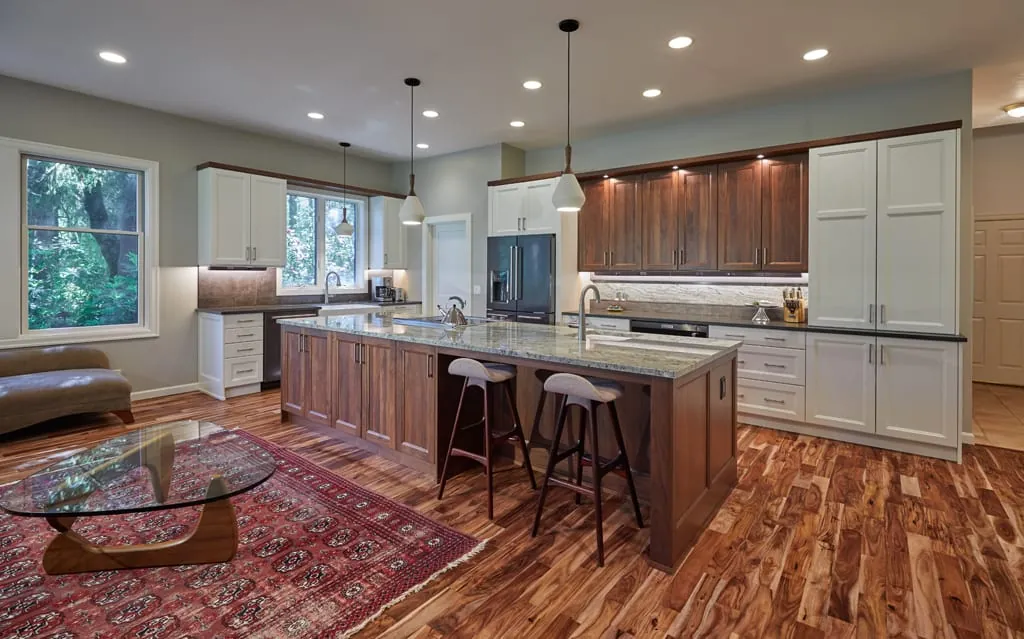
Neil Kelly joined The Natural Step in 1994 and launched its Naturals Collection with water-based finishes in 1998 — years before "non-toxic cabinets" was a search term. The company is an FSC-certified cabinet manufacturer, offers NAUF agriboard boxes with soy-based adhesive, and in 2013 became the first cabinet manufacturer to publish an ILFI Declare label — a full ingredient disclosure — on its Naturally Northwest collection, which was sourced and manufactured within 500 miles of Portland. The parent company has been a certified B Corp since December 2013 (current B Lab score: 80.3).
- Pros: Deepest disclosure stack on this list (FSC + Declare + B Corp); strong indoor air quality focus; limited lifetime warranty
- Cons: Premium pricing; West Coast design-center footprint (ships nationally); Declare label's current database status couldn't be confirmed in our August 2026 check
- Best for: Health-conscious households, especially with children or allergy concerns
3. George Group — Factory-Direct Custom with Certified Materials
Foshan, China · Custom manufacturer serving US and international buyers

George Group — the company behind this site — builds eco-friendly, non-toxic kitchen cabinets for homeowners, builders, importers and developers around the world. Every cabinet is made with FSC-certified wood, CARB2/TSCA-compliant boards and GREENGUARD Gold certified low-VOC finishes, with NAF board available on request — materials chosen so your kitchen is safe to live with from day one. A healthy kitchen is the starting point of a healthy home, and that is what we work toward on every order. For how our factory-direct pricing compares with domestic quotes, see our matched-spec cost comparison.
- Pros: Factory-direct custom pricing; eco materials specifiable at quote stage; export and multi-unit project experience
- Cons: Ocean freight lead time; specs must be locked in writing before production
- Best for: Importers, builders, and homeowners comfortable ordering custom from overseas
4. Puustelli Miinus — The Low-Carbon Outlier
Parent group founded 1920 · Harjavalta, Finland
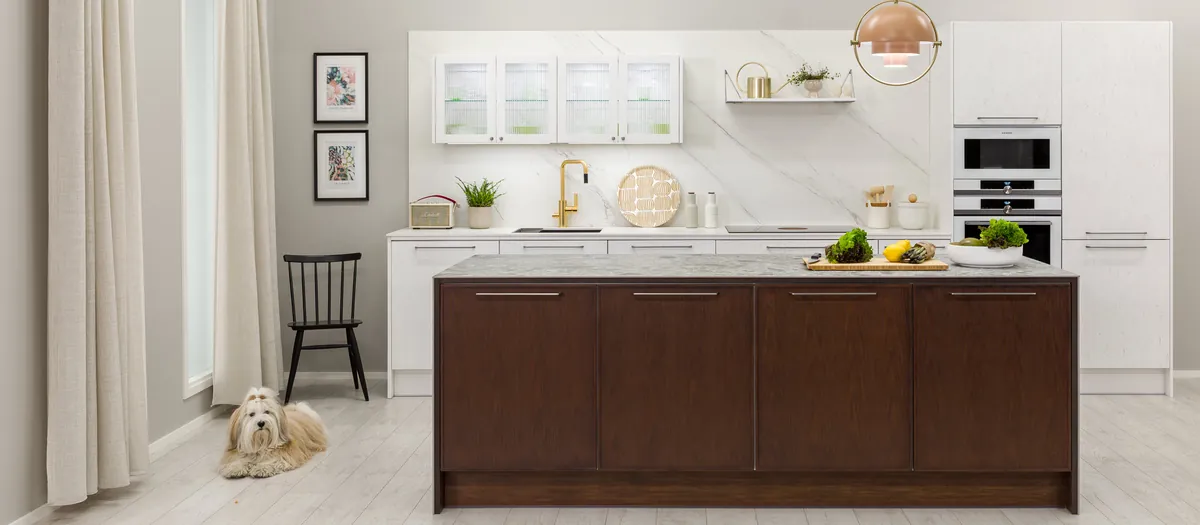
Puustelli's Miinus kitchen replaces MDF and chipboard entirely with a European-patented biocomposite frame made from polypropylene and pulp fiber, assembled with no added-formaldehyde glues. The company reports an M1 emission classification — Finland's strictest indoor-air rating — undercut by almost half, and, per its own lifecycle calculation covering materials, components and transport, CO₂ emissions up to roughly 50% lower than a comparable conventional kitchen (the figure varies with configuration). Puustelli targets carbon-neutral production facilities by 2035, reuses production leftovers or burns them to heat its plants, and states it holds ISO 14001 environmental management certification. US availability is narrow: a Minneapolis-area showroom plus a partner program, and the current US offering centers on Puustelli's SmartFrame biocomposite frames and a Made-in-USA collection rather than imported full Miinus kitchens.
- Pros: The only near-MDF-free construction on this list; recyclable frame material; published carbon methodology
- Cons: Minimalist Nordic styling won't suit traditional homes; very limited US availability
- Best for: Contemporary Scandinavian kitchens where carbon footprint is the priority
5. Executive Cabinetry — Waterborne Finishes as Standard
Formed 2010 (predecessor operating since the mid-1990s) · Simpsonville, South Carolina

Executive's predecessor had already transitioned from solvent-based to all-waterborne finishes before the company was formed in 2010 — eliminating most VOC emissions at the finishing stage as standard, not as an upgrade. That same year, its line became the first residential wood cabinetry to earn GREENGUARD certification for low chemical emissions. No-added-formaldehyde plywood and glues are standard in its board construction. The catalog sits at semi-custom pricing below full-custom brands.
- Pros: Waterborne finishes and NAF board standard; early GREENGUARD milestone; semi-custom pricing
- Cons: Fewer current third-party listings than Crystal or Elmwood — ask your dealer for up-to-date documentation
- Best for: Mid-budget remodels that still want low-VOC finishing
6. Bellmont Cabinet Co. — Certified on a Budget
Founded 1988 · Sumner, Washington · Family-owned
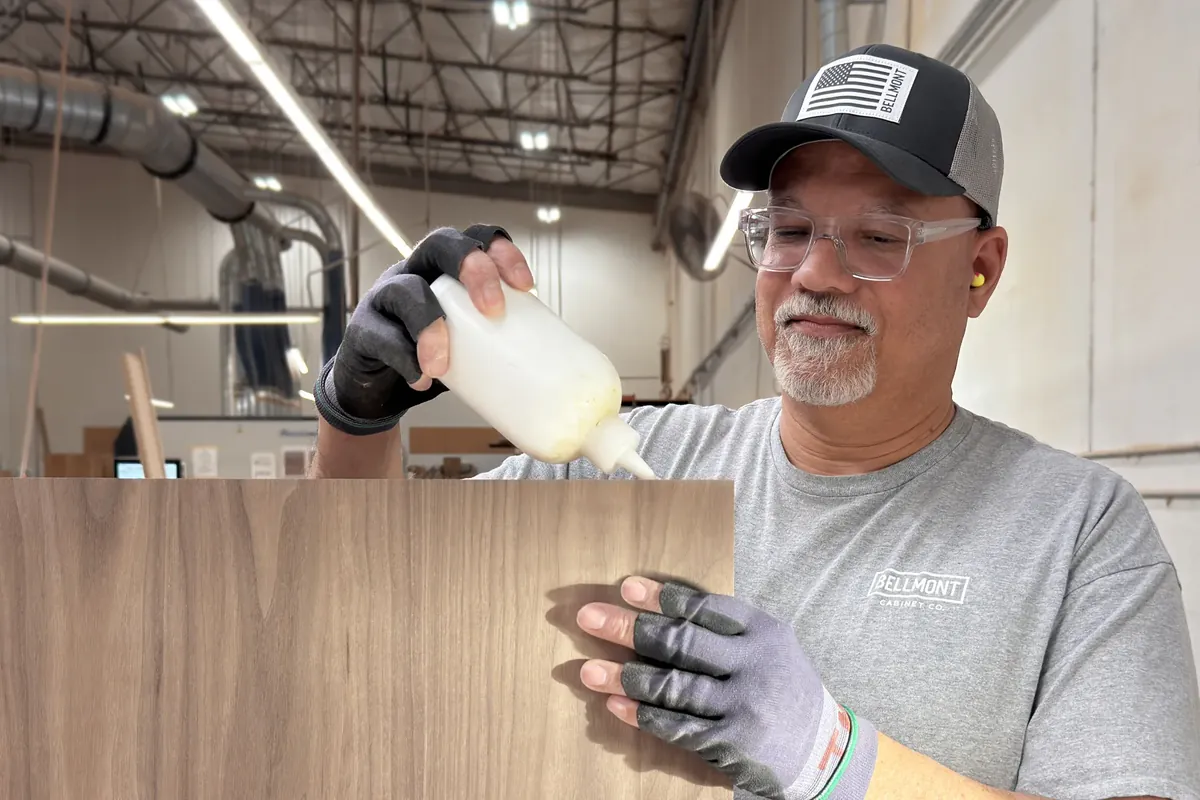
Bellmont proves eco-friendly doesn't have to mean expensive. The frameless specialist states KCMA ESP certification (it appears in KCMA's published member directory), builds to TSCA Title VI — which its warranty documentation notes exceeds and replaces CARB Phase 2 — and runs lean, just-in-time material sourcing documented in a Sherwin-Williams factory case study. Select door styles in its 1300 Series use recycled-PET film made from roughly 25 recycled water bottles per door, and an NAF particleboard option made with FSC-certified mixed-content wood particles has been offered. All lines are frameless.
- Pros: ESP participation at value-to-mid pricing; recycled-content door styles; frameless space efficiency
- Cons: Frameless-only; fewer traditional or carved options
- Best for: First-time buyers who want certified cabinets without custom pricing
7. Plato Woodwork — The Heritage Custom Shop
Founded 1893 · Plato, Minnesota · Family-owned (five generations)
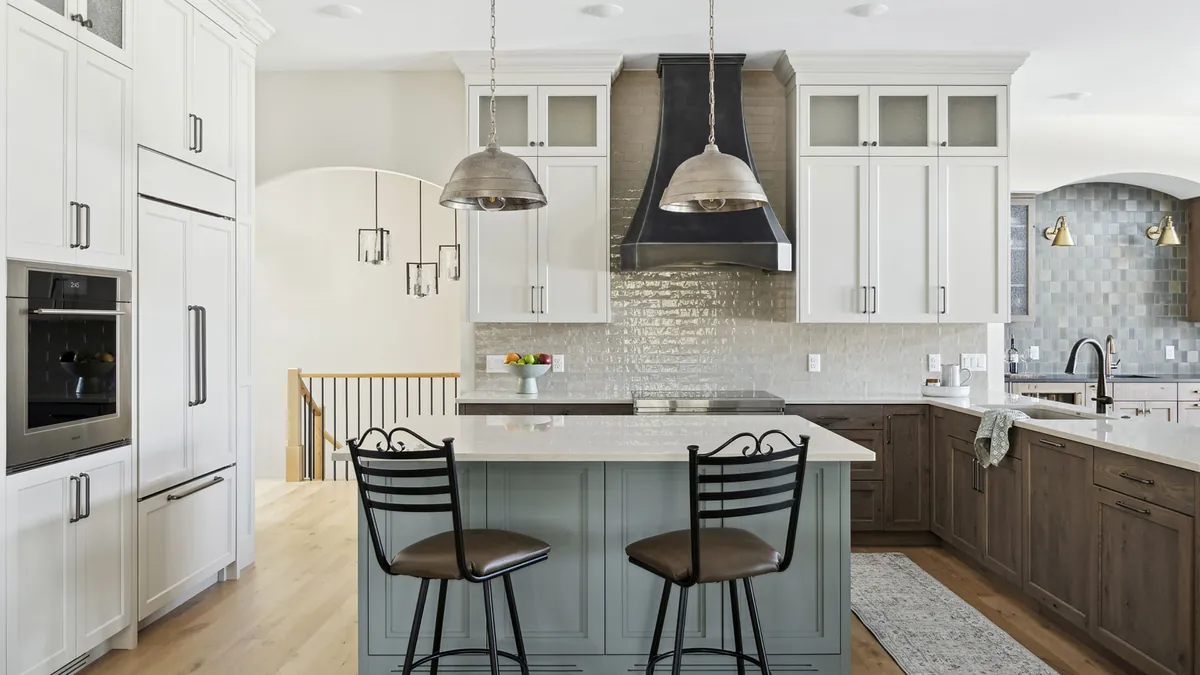
Plato has built custom cabinetry in the same Minnesota town for over 130 years, and its cabinets are built in the USA. The company states that all of its standard materials are certified CARB II compliant and NAUF, and that its topcoats and sealers are low-VOC and HAPs-compliant. Plato has participated in the KCMA ESP program since its first certification in 2008 (as with Crystal, the certificate posted at kcma.org is dated — request the current one). The Prelude line offers a semi-custom entry point below the full-custom Plato line.
- Pros: NAUF as standard material; traditional craftsmanship; long ESP participation
- Cons: Luxury pricing on the custom line; long production lead times
- Best for: Forever-home custom kitchens with classic styling
8. Canyon Creek — The Widest Mid-Range Selection
Founded 1981 · Monroe, Washington · Owned by Sumitomo Forestry since 2011

Canyon Creek holds a place in certification history: in November 2006 it became the first cabinet company ever awarded a KCMA ESP certificate. It publishes an environmental statement (latest edition: November 2024) covering CARB compliance with chain-of-custody documentation, wood-dust collection, packaging-scrap reduction and energy monitoring. Back in 2006 it hosted a Lean & Environment pilot run by the Washington State Department of Ecology and Washington Manufacturing Services, which cut VOCs, raw materials and waste — the EPA later published the case study. Its three lines cover most budgets: Cornerstone (framed), Millennia (frameless) and Katana (value frameless).
- Pros: Widest style and price coverage here; published environmental statement; first-ever ESP certificate
- Cons: Entry-level lines use standard board — specify your material requirements when ordering
- Best for: Buyers balancing budget, style choice, and documented factory practices
9. Crown Point Cabinetry — The Reclaimed-Wood Specialist
Founded 1979 · Claremont, New Hampshire · Family-owned, factory-direct
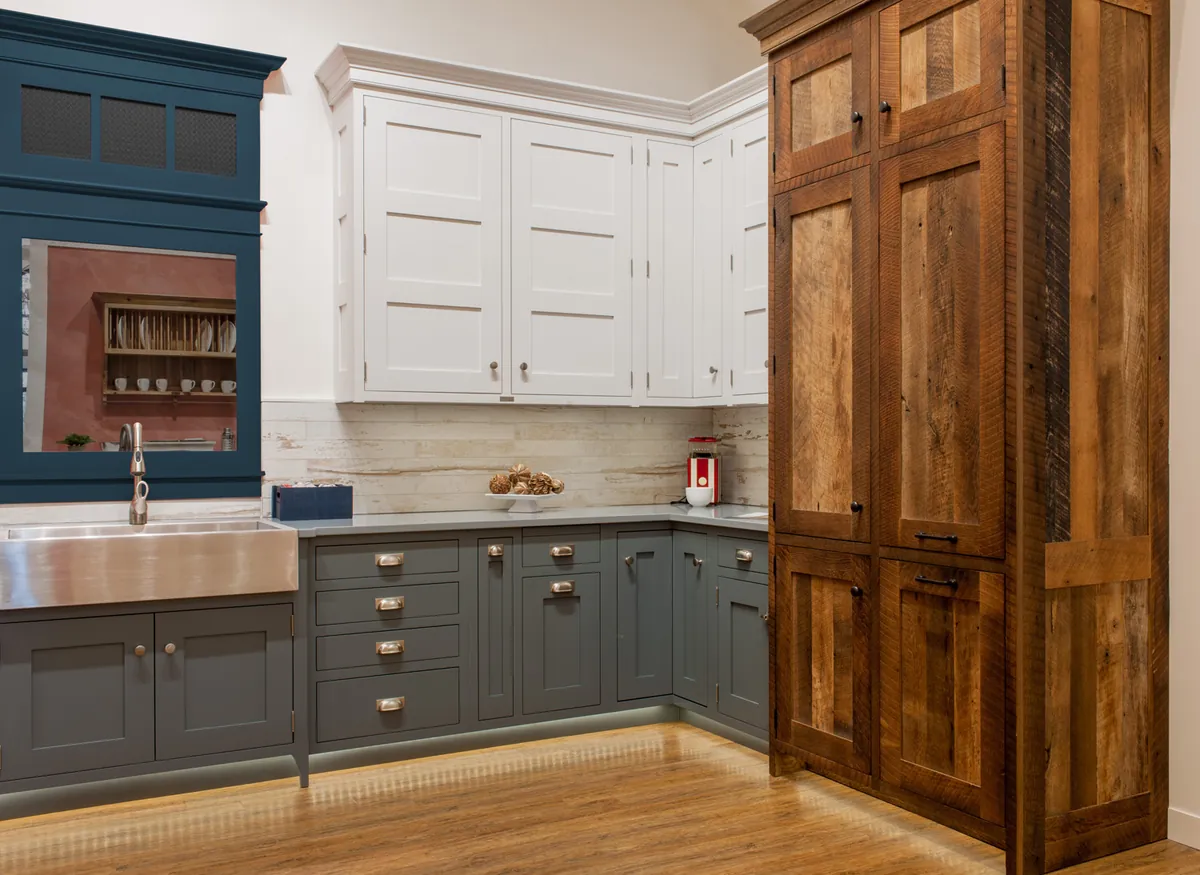
Crown Point is the transparent exception on this list: it appears in no KCMA ESP listing and makes no FSC or GREENGUARD claims on its site — and we say so. What it offers instead is material-level sustainability: a Vintage Collection built from chestnut and oak reclaimed from old barns, factories and large wooden buildings, a catalyzed conversion varnish finish the company states is low-VOC and formaldehyde-free, and handcrafted inset construction designed to last decades (longevity is an underrated eco feature). Crown Point also publishes its pricing openly: a typical custom kitchen runs $55,000–$65,000, most often toward the upper end of that range.
- Pros: Reclaimed-wood line; formaldehyde-free finish (company-stated); honest, published pricing
- Cons: No third-party eco certifications — if certification is your priority, look at Crystal or Elmwood; luxury budget
- Best for: Period and traditional kitchens where reclaimed character matters
10. Elmwood Custom Cabinetry — The Widest Sustainable Material Menu
Founded 1973 · St. Catharines, Ontario · Cabico's high-end custom brand since 2016
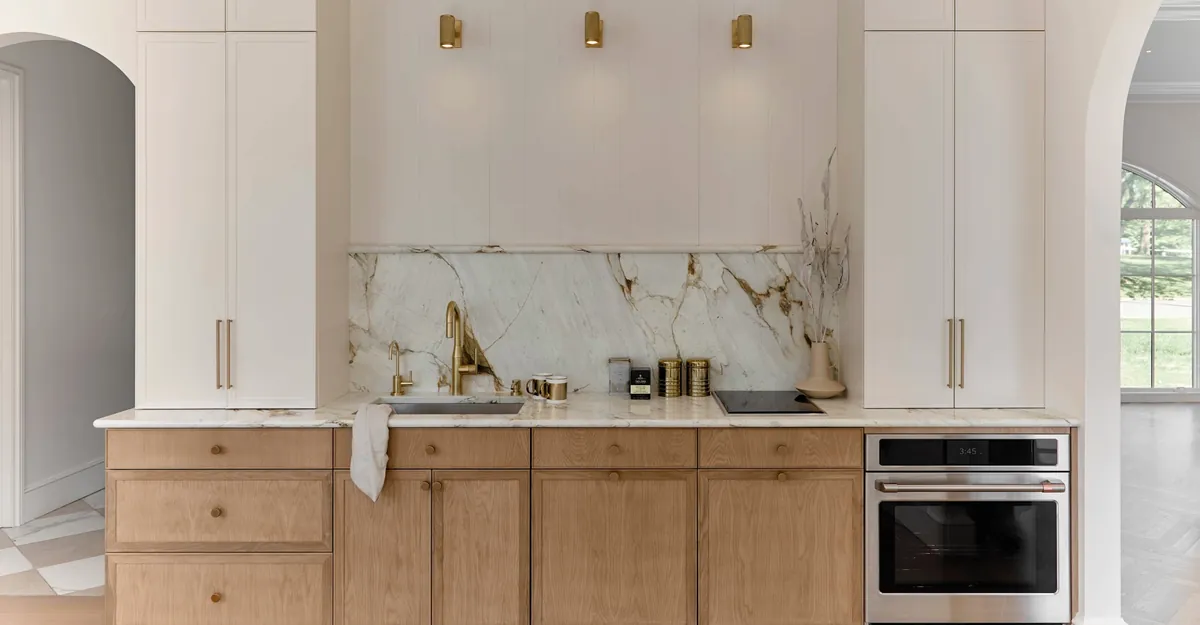
Elmwood holds the strongest currently checkable credential on this list: KCMA ESP certificate ESP 14193, published at kcma.org and valid through April 30, 2027. Per its environmental policy, it builds with CARB-compliant melamine and MDF plus NAF plywood options, and its standout is material choice: Plyboo bamboo doors, Lyptus plantation-grown eucalyptus, engineered veneers, and Kirei Board — a no-added-formaldehyde panel made from sorghum straw — used as the center panel of its Pacifica door. The same policy states that over 75% of finishes are applied in-house under Ontario's HAPs limits, and that the factory recycles solvents, cardboard, plastics and wood.
- Pros: The only brand here with a currently published ESP certificate; bamboo/plantation/NAF door options; wide style range
- Cons: Premium-to-luxury pricing; cross-border shipping adds cost and lead time for US buyers
- Best for: Design-forward kitchens using alternative sustainable materials
Which Certifications Matter Most for Your Project?
Not every certification carries the same weight for every buyer. Start from your project type:
| Buyer | Prioritize | Why It Matters |
|---|---|---|
| Homeowners — especially with children or allergy concerns | GREENGUARD Gold, NAF/NAUF board, waterborne or low-VOC finishes | These govern what your household breathes; cabinets emit most in the first months after installation. |
| Contractors and developers (multi-unit, inspection-driven) | CARB2/TSCA compliance documentation, KCMA ESP | You need paperwork that survives procurement review and supports project documentation such as LEED low-emitting materials credits — not marketing claims. |
| Importers and overseas buyers | FSC chain-of-custody number, CARB2/TSCA compliance statement written into the quote | Customs and project specifications ask for documents, and board specs must be locked before production starts. Weigh ocean-freight emissions in the footprint math too. |
Whatever your project type, the next step is the same: verify the claim before you pay.
How to Verify a Brand's Eco Claims (Before You Buy)
Any brand can print "green" on a brochure. Here's how to check the claims that matter, in under ten minutes:
- KCMA ESP: Look up the company in the ESP listing at kcma.org — and check the certificate's expiration date. During our August 2026 review, several posted certificates were years old; if the listing looks dated, ask the brand for its current certificate.
- FSC: Ask for the chain-of-custody certificate number and verify it at search.fsc.org. "FSC-sourced" without a certificate number is a marketing phrase.
- GREENGUARD Gold: Search the exact product line (not just the brand name) in UL's SPOT database at spot.ul.com.
- CARB2 / TSCA Title VI: This is the legal floor for composite wood sold in the US, not a premium feature. If a seller can't produce a compliance statement, walk away.
- NAF/NAUF: Get it on the written quote or spec sheet. Board specs are swapped easily between "standard" and "upgrade."
Watch for greenwashing patterns: vague terms with no standard named ("eco-conscious," "planet-friendly"), certifications that expired or apply to one product only, and carbon claims with no published methodology.
Planning an Eco-Friendly Kitchen?
Send George Group your layout, dimensions and material requirements — NAF board, low-VOC finish, certified wood — and we will prepare a custom cabinet plan with an itemized quote. Single kitchen or multi-unit build.
FAQ
Explore George Group's kitchen cabinet range, review the custom kitchen cabinet service, or read the related guides to buying kitchen cabinets from China (supplier verification and safeguards) and custom cabinet cost (how to compare two quotes on the same specification).
Data Sources and Method
- Crystal Cabinets: Environmental Stewardship FAQ — NAF boxwork standard since April 2025; CARB2/TSCA compliance; GREENGUARD Gold topcoat scope (stains, Keyline/Encore lines).
- KCMA: ESP certificate ESP 14193, The Elmwood Group Limited / Cabico — valid through April 30, 2027; the only currently published ESP certificate retrieved in this review.
- B Lab: Neil Kelly Company B Corp profile — certified since December 2013, current score 80.3.
- Woodworking Network (2013): Neil Kelly's first Declare label — first cabinet manufacturer with an ILFI Declare-labeled collection.
- Puustelli: European patent for Miinus furniture and Puustelli: carbon-neutral production target — biocomposite frame, carbon figures and 2035 target as published by the company.
- PR Newswire (2010): first GREENGUARD-certified residential wood cabinetry — Executive Cabinetry milestone.
- Bellmont: warranty documentation (TSCA Title VI statement), 1300 Series (recycled-PET door styles), and Sherwin-Williams case study (lean, just-in-time sourcing).
- Canyon Creek: Environmental Statement (November 2024) and US EPA: Canyon Creek case study — 2006 Lean & Environment pilot run by Washington State agencies.
- Crown Point: How Do I Buy Direct (published $55,000–$65,000 kitchen range), Wood Species (Vintage Collection reclaimed woods), and finishes page (low-VOC, formaldehyde-free claim).
- Plato Woodwork: environment page — CARB II / NAUF standard materials and low-VOC HAPs-compliant topcoats as stated by the company.
- Elmwood: environmental policy — CARB-compliant boards, NAF options, Plyboo/Lyptus/Kirei materials, in-house finishing and recycling as stated by the company (policy page predates the Cabico acquisition; the current ESP certificate above is the third-party anchor).
Method note: all claims were checked against public sources on August 21, 2026. Entries distinguish third-party verified credentials (certificates or issuing-body listings) from company-stated practices. Where a posted certificate had expired or a directory could not be queried, the article says so. Certifications can change — re-verify before making a purchase decision.