Plywood vs. MDF Cabinet Boxes: Which Material Belongs Where
The honest answer is rarely one material for the whole cabinet. Here is what published standards and manufacturer specifications say about strength, moisture, emissions, cost and lead time — how to match the material to your budget, climate and timeline, and what to watch after installation.
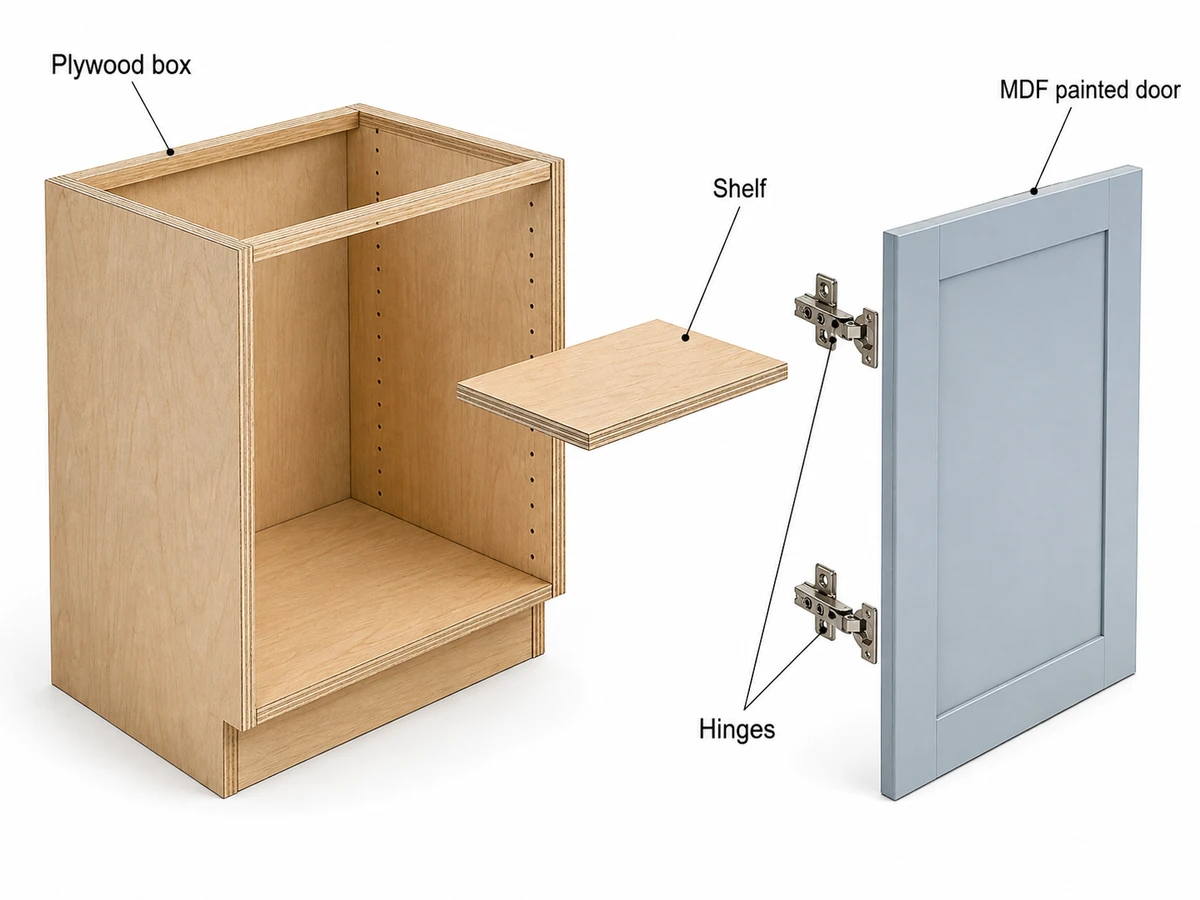
For cabinet boxes, plywood is the safer default; for painted door panels, MDF is the industry-standard substrate. Plywood's cross-laminated structure holds hinge and shelf screws better — especially at panel edges — and tolerates occasional moisture far better than standard MDF or particleboard. MDF's uniform, grain-free surface takes paint, lacquer and foil finishes more smoothly than any veneer core, which is why many well-built kitchens combine a plywood box with MDF doors.
Plywood boxes matter most for: sink bases and cabinets next to dishwashers, wall cabinets carrying heavy loads, humid or coastal climates, and kitchens you expect to use hard for 10+ years. MDF-forward construction can be acceptable for: dry areas, painted door and drawer fronts, and budget-driven projects where the sink base is upgraded to plywood or a moisture-resistant (MR) grade board.
The Three Materials at a Glance
Most cabinet boxes in North America are built from one of three panels: veneer-core plywood, medium-density fiberboard (MDF), or particleboard. If you are still weighing where MDF fits among the options overall, our MDF cabinets guide covers that material on its own; this article is about the comparison. The table below summarizes what published specifications and standards say.
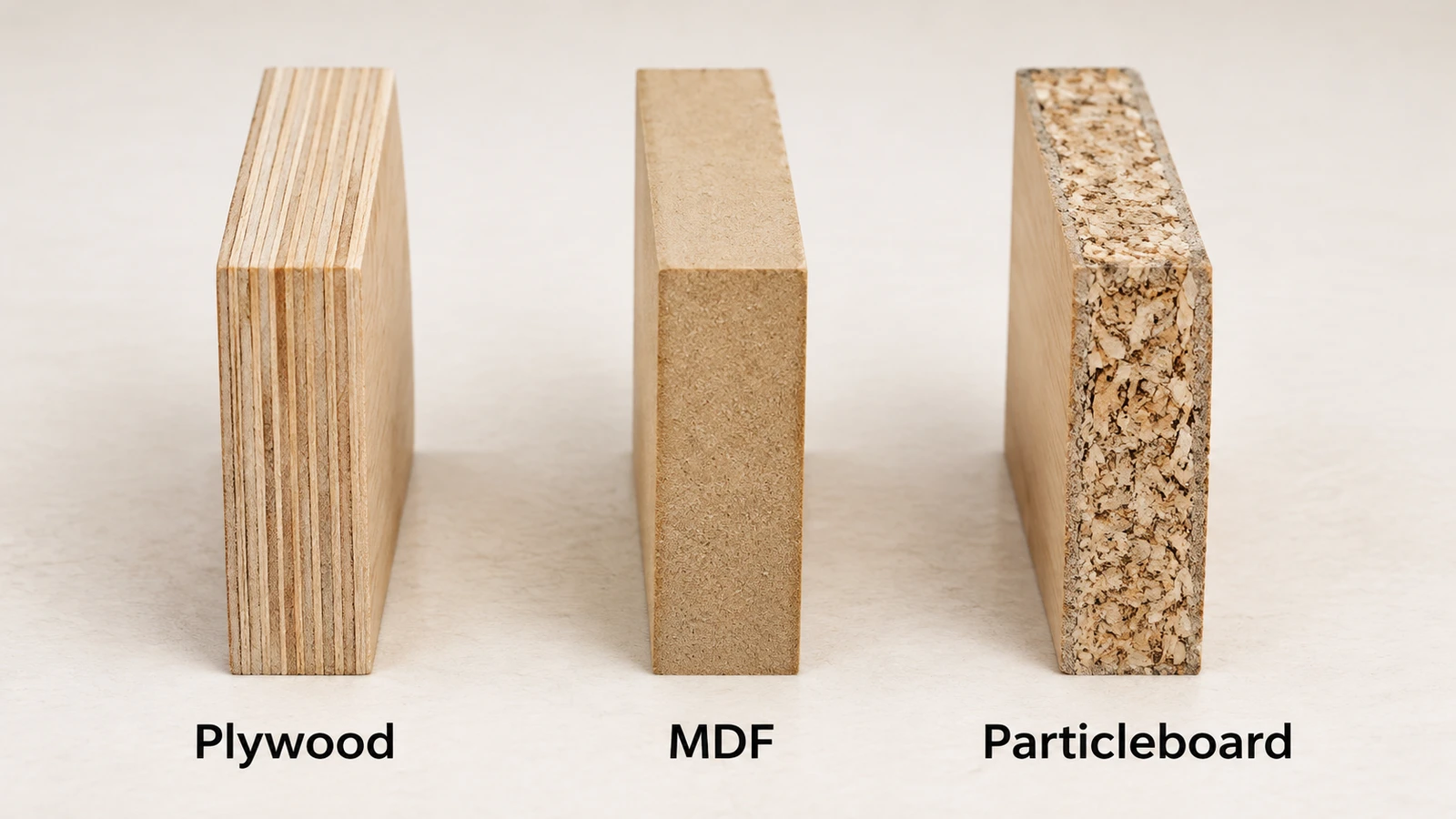
| Property | Cabinet-grade plywood | MDF | Particleboard |
|---|---|---|---|
| Hinge & hardware screws | Strongest, especially at edges — hinges stay tight through years of door cycles | Weaker edge grip; hinge screws can loosen or strip with repeated adjustment | Similar edge-grip weakness; a common failure point on budget RTA cabinets |
| Occasional moisture | Exposure 1 glue bond tolerates occasional wetting; cross-laminated plies resist warping and swelling (APA) | Standard MDF swells irreversibly when soaked; MR-rated MDF must pass ≤5.5% thickness swell in a 24-hour soak (ANSI A208.2 §3.6) | Weakest of the three when wet; swelling is not reversible |
| Typical density / weight | Generally the lightest of the three at equal thickness (reference values around 28–31 lb/ft³ for softwood plywood) | The densest common cabinet panel — reference values reach ~50 lb/ft³; CPA describes its profile as dense and uniform | ~40–48 lb/ft³ — lighter than MDF, heavier than softwood plywood |
| U.S. formaldehyde limit (TSCA Title VI / CARB Phase 2) | 0.05 ppm | 0.11 ppm (0.13 ppm for thin MDF) | 0.09 ppm |
| Painted / foiled finish quality | Grain can telegraph through paint over time | Flat, uniform, knot-free surface — the standard substrate for lacquer and foil doors (Composite Panel Association) | Usually laminated or foil-wrapped rather than painted directly |
| Retail sheet price sample (Home Depot online, Sep 2026) | ~$75 per 3/4″ 4×8 birch sheet | ~45–50 per 3/4″ 4×8 sheet | Generally below MDF |
Sources: APA – The Engineered Wood Association, Composite Panel Association, U.S. EPA; density reference values from Wiley, Encyclopedia of Polymer Science and Technology (Wood Composites chapter). Price is a single-retailer online list sample, not a national average. Full source list at the end of this article.
Why Boxes and Doors Deserve Different Answers
The most common buyer question — "are your cabinet boxes plywood?" — assumes one material should win everywhere. In practice, boxes and doors fail in different ways, so the smarter question is which material sits on which part.
Where boxes fail: screws, water, sag
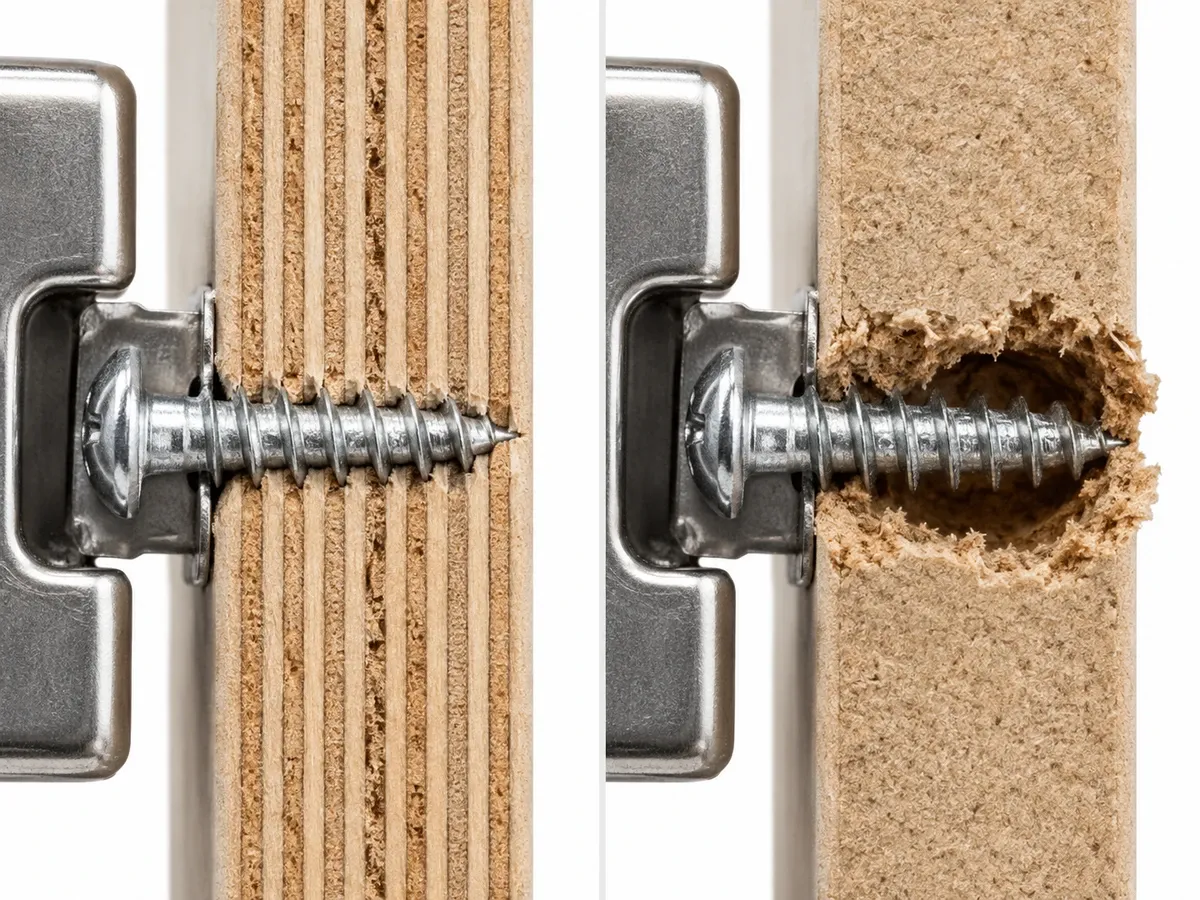
- Hinge and hardware screws. Doors open thousands of times a year, and every cycle loads the screws in the box side panel. APA rates plywood's fastener holding as excellent — its cross-laminated plies grip screws in both face and edge — while MDF and particleboard edges crumble more easily under repeated hinge adjustment. That is why hinges stay tight longer in plywood boxes.
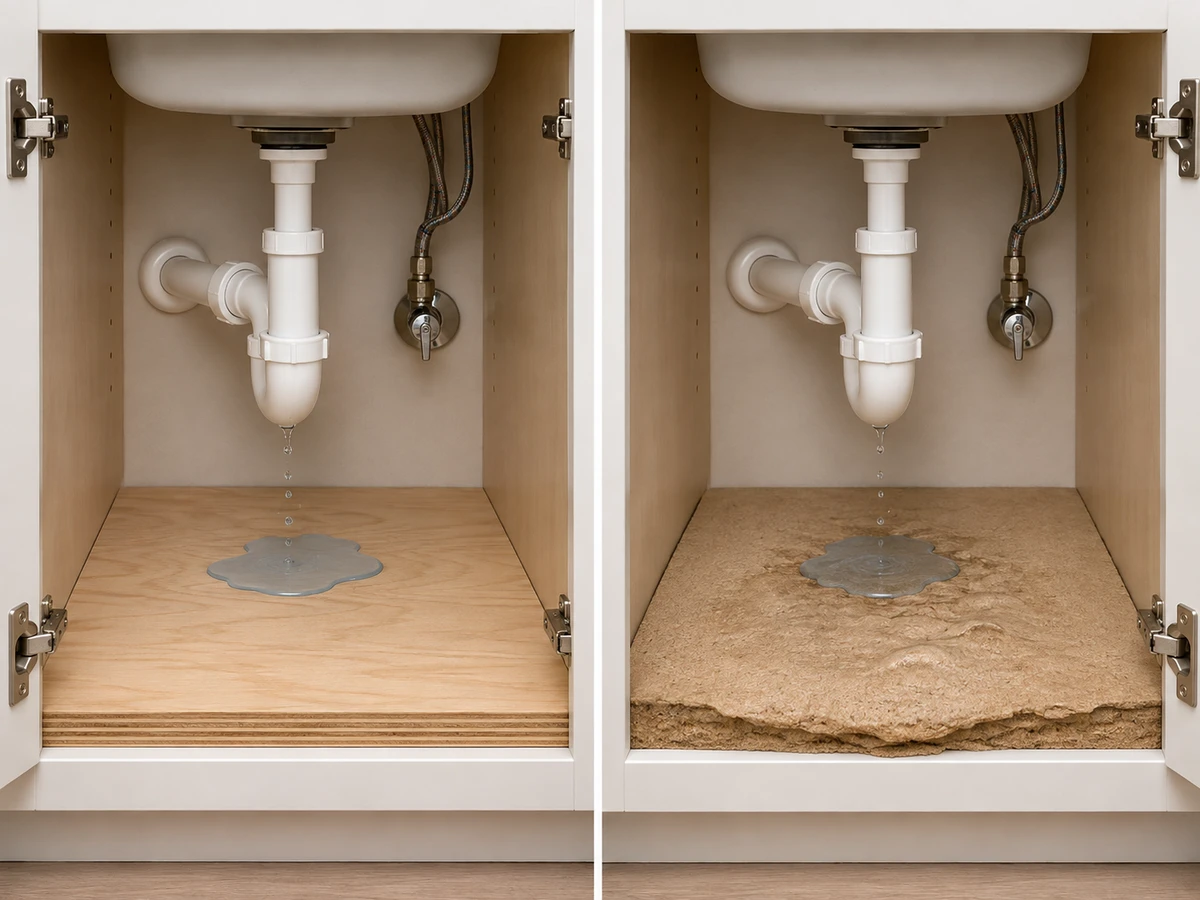
- The sink base. Slow plumbing leaks and dishwasher steam are the most common way cabinet boxes die. Standard MDF and particleboard swell permanently once soaked; plywood with an Exposure 1 glue bond shrugs off occasional wetting.
- Shelf sag. Long, loaded shelves in MDF or particleboard can creep into a visible bow over the years. Plywood's stiffness per pound is higher, and it weighs roughly a third less per sheet — which also matters when wall cabinets are hung.
Where doors fail: the finish
- Painted and lacquered fronts. MDF's homogeneous density lets shops machine crisp profiles and spray a smooth finish with no grain pattern underneath. The Composite Panel Association describes MDF's surface as flat, smooth and free of knots and grain — exactly what high-gloss lacquer needs.
- Foil and thermofoil fronts. Vacuum-pressed foil doors are almost always MDF-core for the same reason.
- Doors don't hold boxes up. A door panel carries almost no structural load and rarely sees standing water, so plywood's strength and moisture advantages matter far less here.
Put the two halves together and the pragmatic specification writes itself: plywood boxes, MDF painted doors, and an upgraded sink base. That combination is not a compromise — it is each material doing the job its structure is best at.
Match the Material to Your Situation
The right answer changes with your budget, your climate, and how fast you need the kitchen. These four factors decide more than any material slogan.
Budget: where the plywood premium is worth paying
At the panel level, cabinet-grade plywood costs roughly 1.5–1.7× MDF in our September 2026 retail sample (~$75 vs ~$45–50 per 3/4″ sheet). In a finished cabinet, though, the panel is only one cost line — hardware, finish labor, packaging and freight routinely outweigh it. That means two things for your budget. First, moving from all-MDF to all-plywood construction adds a real but moderate premium to a full order. Second, a quote that comes in far below the market deserves a material question before a celebration: check whether the box spec quietly moved to particleboard. If the budget is tight, the cost-effective compromise is not all-plywood-or-nothing — it is plywood (or MR board) in the wet and load-bearing positions, MDF elsewhere. Our guide to comparing cabinet quotes on a matched specification shows how to line two quotes up line by line before comparing totals.
Environment: humidity and water exposure decide faster than taste
Climate and room conditions should override style preferences. In humid or coastal regions, plywood boxes are the safer baseline, and outdoor kitchens need different construction entirely (more below). In dry inland homes with normal ventilation, MDF boxes perform acceptably for years. Regardless of climate, three positions in every kitchen see water routinely: the sink base, the cabinet beside the dishwasher, and the trash-pullout cabinet. Treat those three as non-negotiable upgrade positions, whatever the rest of the order uses.
Timeline: stock speed vs. custom fit
If the schedule drives the project, stock and RTA lines — usually MDF or particleboard construction — can ship in days to a few weeks, because the sizes are pre-made. Custom production runs on a longer clock: at George Group, for example, production typically takes 35–45 days after shop drawings are approved, plus ocean freight for international orders. The trade is exact fit, full material choice and specification control. A practical middle path many renovators use: order custom for the kitchen you will keep, and avoid rushing a permanent kitchen into a stock-cabinet decision just to save a month.
Buyer type: who you are changes what "good" means
| Your situation | Sensible specification | Why | Watch out for |
|---|---|---|---|
| Homeowner, long-term kitchen (10+ years) | Plywood boxes + MDF painted or veneer doors | Hardware longevity and sink-base survival dominate lifetime cost | Skipping the sink-base upgrade to save a small line item |
| Rental property or pre-sale refresh | MDF boxes with laminate/foil doors; plywood sink base | Lower upfront cost; finish still looks sharp in listings | Particleboard boxes — tenant damage and water shorten their life fast |
| Contractor, multi-unit or development order | Plywood boxes at least in wet zones, consistent hardware brand across units | Warranty claims and callback labor cost more than the panel upgrade | Quotes that swap box material between sample and production run |
| Importer / dealer building a product line | Plywood-box tier + MDF-box tier, clearly labeled | Two price points without hiding the construction difference | Mixed containers with undocumented material differences per batch |
What the Standards Actually Guarantee
Marketing words like "premium board" mean little. These are the labels and standards that carry enforceable meaning in North America.
Emissions: TSCA Title VI / CARB Phase 2 is a legal floor, not a quality grade
Since March 2019, composite wood panels sold in the U.S. must meet EPA TSCA Title VI emission limits, which the EPA states are identical to CARB's ATCM Phase II limits: 0.05 ppm for hardwood plywood, 0.09 ppm for particleboard, 0.11 ppm for MDF and 0.13 ppm for thin MDF (large-chamber test method). Any compliant panel — plywood or MDF — clears the same legal bar for its category. Compliance does not mean formaldehyde-free; NAF (no-added-formaldehyde) and ULEF products are separate, stricter categories worth asking about if indoor air quality is a priority.
MDF quality: ANSI A208.2 grades
North American MDF is graded under ANSI A208.2, the standard published by the Composite Panel Association. Per the CPA's technical bulletin, the mid-range Grade 130 — a common reference point for cabinet-grade board — specifies a modulus of rupture of 3,130 psi and modulus of elasticity of 313,000 psi (2016 edition values; the current edition is A208.2-2022). The standard also defines moisture-resistant designations: an MR-rated MDF must show no more than 5.5% thickness swell after a 24-hour water soak. If a quote says "moisture-resistant MDF," this is the test that claim should map to.
Plywood construction: APA PS 1 / PS 2 and glue bond classes
Structural plywood in the U.S. is covered by the APA's PS 1 and PS 2 standards, recognized by all major U.S. building codes. For cabinets, the relevant detail is the bond classification: Exposure 1 panels use waterproof exterior glue and tolerate occasional wetting during construction and service, while Exterior panels withstand repeated wetting and drying. Note what the rating does not say — Exposure 1 is not a waterproofing guarantee, and no bond class makes any wood panel immune to standing water.
Finished cabinets: ANSI/KCMA A161.1 tests the cabinet, not the board
The Kitchen Cabinet Manufacturers Association's A161.1 standard certifies finished cabinets through 14 third-party tests on production samples: shelves loaded at 15 pounds per square foot for seven days, wall cabinets loaded progressively to 600 pounds, 25,000 door open-close cycles, and a 24-hour hot box at 120°F and 70% relative humidity, among others. A KCMA seal tells you the whole cabinet survived a simulated service life. It does not, by itself, prove one board type is better than another — well-built cabinets of either material can pass, which is exactly why the box/door split above matters more than the badge.
What the Raw Panels Cost
Material is only one line in a finished cabinet's price, but it sets the floor. In a September 2026 sample of Home Depot online list prices, a 3/4″ 4×8 MDF sheet listed at roughly $45–50, while a same-size birch-faced cabinet-grade plywood sheet listed near $75. Treat this as a one-retailer snapshot, not a national average; store pricing varies by region. The budget section above covers what this ratio does — and does not — mean for a finished order.
After You Buy: Benefits, Drawbacks and What to Watch
Material choice keeps mattering after installation day. Here is what each choice gives you, what it costs you, and the habits that protect it.
If you chose plywood boxes
- Benefits: hinges and drawer slides stay tight through years of use; shelves resist sag under dishware loads; the odd plumbing leak or wet umbrella in the sink base is recoverable rather than fatal; lighter boxes are easier on installers and wall fixings.
- Drawbacks: higher material cost; if boxes are painted rather than laminated, wood grain can faintly telegraph through the finish over time.
- Still prevent: plywood tolerates occasional wetting — it is not waterproof. Fix leaks promptly, and keep a drip tray or mat in the sink base. Retighten hinge screws once a year; even the best substrate relaxes slightly with use.
If you chose MDF boxes or MDF-core doors
- Benefits: the smoothest painted finish in the category; no grain movement, so painted doors stay visually stable through seasonal humidity swings; lower cost frees budget for better hardware or countertops.
- Drawbacks: MDF is the heaviest common cabinet panel — wall cabinets are heavier to hang and need proper anchors into studs, not drywall plugs. Water damage is irreversible, and chipped foil or thermofoil edges cannot be invisibly repaired.
- Must prevent: never let water stand in an MDF sink base — use a fitted tray and check the trap and supply lines every few months. Clean with a damp, not wet, cloth and dry immediately. Avoid over-tightening screws into MDF (it strips more easily than plywood), and if a hinge loosens, move the hinge to a fresh position rather than forcing a larger screw into the swollen hole.
If you bought particleboard RTA cabinets
- Benefits: the lowest entry price and the fastest availability; fine for short-horizon properties and light-use kitchens.
- Drawbacks: shortest service life of the three under heavy use; cam-lock and dowel joints loosen with disassembly and moving.
- Must prevent: don't overload wall cabinets, add center supports under long shelves, and treat any water event as urgent — particleboard swells fastest of the three.
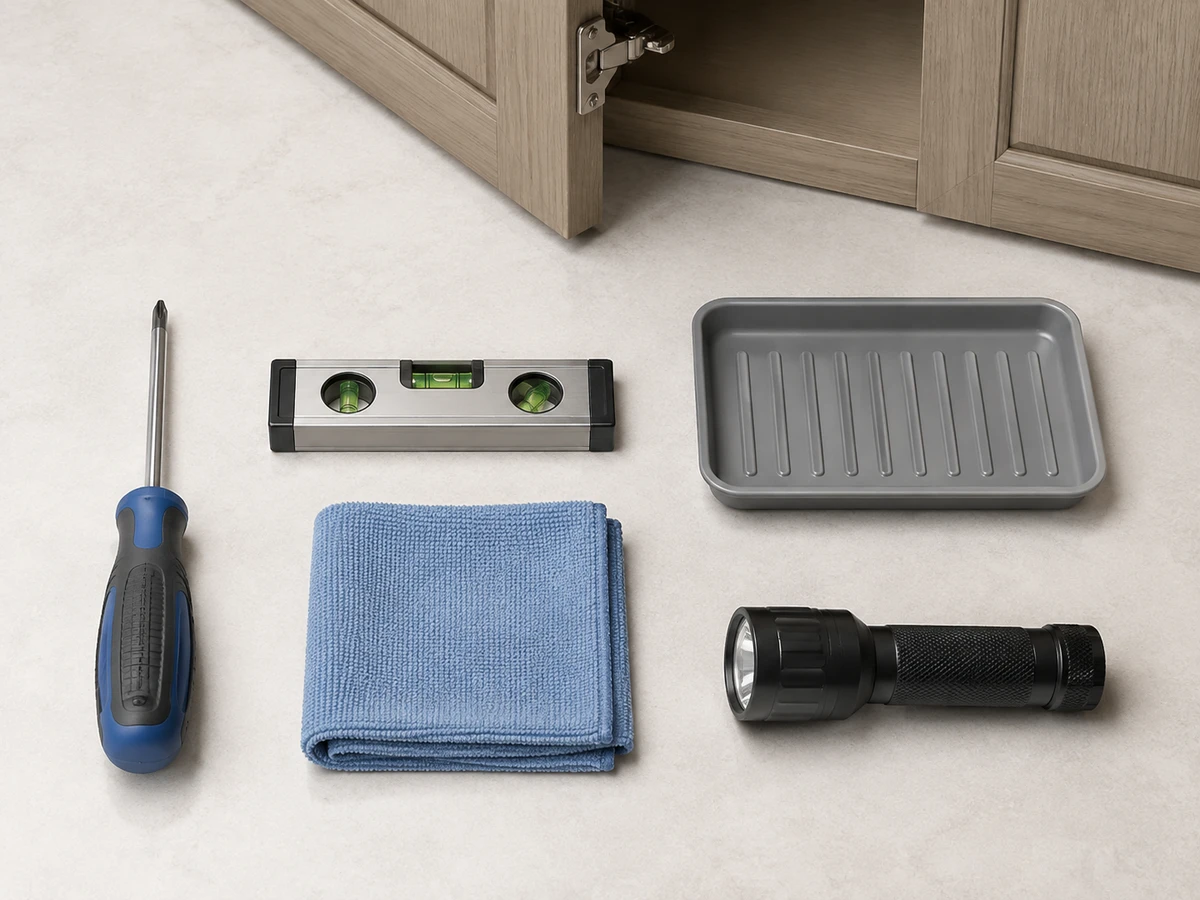
- Open the sink base and run a dry hand along the floor of the cabinet — moisture you can feel is a leak you haven't seen.
- Tighten hinge and drawer-slide screws; adjust door alignment while you're there.
- Check caulk lines where countertop meets backsplash and around the sink cutout.
- Wipe door faces with a damp cloth and dry them; standing moisture dulls even good lacquer.
- Confirm wall-cabinet fixings show no gap opening between box and wall.
How George Group Builds Cabinets — and How You Can Verify It
George Group's standard cabinet construction uses 18mm plywood boxes with edge banding, soft-close hardware from Blum or Hettich, and panels compliant with CARB Phase 2 / EPA TSCA Title VI, with FSC-certified material available. Dimensional tolerance on shop drawings is ±1mm, cabinets carry a 10-year limited structural warranty, and typical production runs 35–45 days after drawings are approved. Painted and lacquered door fronts use MDF or HDF substrates for finish quality; wood-finish fronts use veneer or solid wood depending on the design.
These are the same specifications published on our product pages, and they are checkable on delivery. If you are comparing suppliers, ask each one the questions below — including us.
- Read the panel label or certification. TSCA Title VI compliance labeling is required on panels or finished goods sold in the U.S.; ask for the certificate scope and the fabricator's name on it.
- Look inside the sink base first. Unfinished cutouts and the back of the sink base reveal the actual box material — ply layers are visible at a plywood edge; MDF shows a uniform fiber core. Confirm the sink base spec matches the quote.
- Check hinge screw bite. Open and close a wall-cabinet door firmly. Screws seated in plywood edge grain resist wobble; a hinge that shifts on day one will not improve with age.
- Measure box thickness. Confirm panels match the quoted thickness (for example, 18mm) rather than a thinner substituted board.
- Run your hand across a painted door. A smooth, grain-free finish indicates an MDF/HDF substrate doing its job; visible grain texture under paint means a veneer-core door was substituted.
- Ask about the sink base upgrade path. If the order is MDF or particleboard boxes for budget reasons, the sink base and dishwasher-adjacent cabinet are the two positions worth paying to upgrade.
Send Us Your Floor Plan or Existing Quote
We will return a specification-locked quote — box material, board thickness, hardware brand and finish system stated line by line — so you can compare it against any other offer on equal terms.
When Neither Material Is the Answer
- Coastal and outdoor kitchens. Persistent humidity and direct weather call for marine-grade plywood, stainless steel or HDPE-style polymer cabinets rather than standard interior board. The kitchen cabinet range includes outdoor-specific construction for this reason.
- Very long unsupported shelves. Past a certain span and load, no panel material replaces a center support or a thicker shelf; the CPA's shelving bulletin gives deflection-based sizing rather than material slogans.
- Solid-wood doors in humid climates. Solid wood moves with humidity; a stable MDF-core door with real veneer often performs more predictably — a separate decision from box material, covered in our guide to laminate vs. solid wood cabinets.
Methodology and Sources
This article compares panel materials using published standards from U.S. regulators and industry associations, not third-party blog data or a single lab test. The screw-holding comparison is qualitative by design, following APA's published fastener-holding guidance rather than mixing figures from incompatible test methods. Density reference values come from Wiley's Encyclopedia of Polymer Science and Technology. The price sample is one major retailer's online list price observed in September 2026 and is not a market average. Lead-time figures reflect general market practice for stock lines versus George Group's published custom production window. Standards referenced: EPA TSCA Title VI / CARB ATCM Phase II (emission limits identical per EPA), ANSI A208.2 (MDF), APA PS 1/PS 2 (plywood), ANSI/KCMA A161.1 (finished cabinets).
- U.S. EPA — Frequent Questions for Consumers about the Formaldehyde Standards for Composite Wood Products Act (TSCA Title VI limits table)
- U.S. EPA — Formaldehyde Emission Standards for Composite Wood Products: Rule Summary
- CARB — Composite Wood Products ATCM program
- Composite Panel Association — ANSI A208.2 (MDF standard); Medium Density Fiberboard product overview; Particleboard & MDF for Shelving technical bulletin
- APA – The Engineered Wood Association — Plywood (PS 1 / PS 2, bond classifications)
- KCMA — Cabinets Certified to Last; The ROI of Durable Cabinets (ANSI/KCMA A161.1)
- Wiley — Encyclopedia of Polymer Science and Technology, Wood Composites chapter (panel density reference values)
- Home Depot — online list price sample for 3/4″ 4×8 panels, observed September 2026 (single-retailer sample, not a market average)
FAQ
Planning a Kitchen, Villa or Development Order?
George Group builds custom cabinets to verified specifications — 18mm plywood boxes, Blum/Hettich hardware, CARB Phase 2 / TSCA Title VI compliant panels — with shop drawings you approve before production starts.