Whole-House Customization from China: How to Compare Factory Quotes, Control QC, and Avoid Costly Scope Gaps
Quick answer: Buying whole-house customization from China can simplify a multi-room project, but only if you compare quotes on the same specification, lock QC checkpoints before production, and clarify what is excluded from the price.
Suitable for: apartment developments, villas, hotels, and renovation projects that need cabinets, wardrobes, doors, tiles, lighting, or furniture from one coordinated supplier.
Not suitable for: buyers who only need a single stock item, cannot provide drawings or a bill of quantities, or are not ready to confirm specifications before production.
Before requesting quotes, prepare three things: a floor plan or drawing set, a room-by-room product list, and your target delivery terms. This guide includes a quote-checking table and a supplier checklist you can copy and use before paying a deposit.
YoloDeco is the whole-house customization and building materials team under George Group, serving developers, contractors, importers, and homeowners. Based in Foshan, we manufacture and source kitchen cabinets, wardrobes, bathroom vanities, doors, windows, tiles, lighting, and furniture, and consolidate them into one shipment when the project calls for it. Our team handles 3D design, shop drawings, production, QC, and container loading under one coordinated workflow, so you are not managing several unrelated factories at once.
In this guide:
- Start with the right buying package
- Break the quote into comparable line items
- Put every quote on the same basis
- Lock QC checkpoints before production
- Verify certifications for your destination
- Plan the production and delivery timeline
- How YoloDeco handles a multi-category project
- Where whole-house projects go wrong
- Terms to lock in the Proforma Invoice
- Supplier checklist before you pay a deposit
Want a similar whole-house solution for your project? Send us your drawings or room list, and our team will review them for free.
WhatsApp UsStart With the Right Buying Package
Whole-house customization is not one product. It is a procurement package that may include kitchen cabinets, wardrobes, bathroom vanities, interior doors, wall panels, tiles, sanitary ware, lighting, and loose furniture. The first decision is not which supplier is cheapest. It is which items should be made to order, which should be sourced as standard products, and which should be bought locally.
Custom-made items usually need drawings, finish samples, and production time. Standard items may be easier to compare by model and specification. Installation-sensitive items, such as flooring or local electrical work, may still require a local contractor even when the materials come from China.
A practical buying list should separate the project into three groups:
- Custom production: kitchen cabinets, wardrobes, bathroom vanities, wall panels, and made-to-size doors.
- Coordinated sourcing: tiles, sanitary ware, lighting, hardware, and furniture.
- Local scope: installation, site modification, electrical connection, plumbing connection, and final touch-up unless specifically included.
Break the Quote Into Comparable Line Items
A whole-house quote is difficult to compare when each supplier uses a different structure. One may price cabinets by linear meter, another by unit, and another by project package. One may include hardware and packaging, while another lists them later.
Ask each supplier to quote in a format that shows the product, specification, unit, quantity, packaging, and exclusions. A usable quotation normally contains fields like these:
| Quote field | What to check | Common gap |
|---|---|---|
| Product and room | Which room or apartment type the item belongs to | One total price with no room breakdown |
| Dimensions | Width, height, depth, and whether sizes are confirmed by drawings | Estimated sizes used for pricing without final measurement |
| Material and finish | Board type, thickness, surface finish, edge banding, and color | "Wood cabinet" or "gloss finish" without a specification |
| Hardware | Hinge, slide, handle, brand, and model range | Premium hardware shown in renders but not included in price |
| Unit and quantity | Per unit, square meter, linear meter, set, or package | Different units across suppliers |
| Packaging | Carton, pallet, wooden crate, and export protection | Packaging upgraded after the quote is approved |
| Accessories | Sink, faucet, basin, mirror, lights, and installation accessories | Accessories shown in the design but excluded from supply |
| Trade term | EXW, FOB, CIF, DDP, or another agreed term | Freight, duty, and local delivery left unclear |
For tiles and other materials subject to cutting waste, check whether the quantity includes an allowance for loss. For cabinets and wardrobes, check whether fillers, end panels, toe kicks, and decorative panels are included. These items often explain why two apparently similar quotes are not actually comparable.
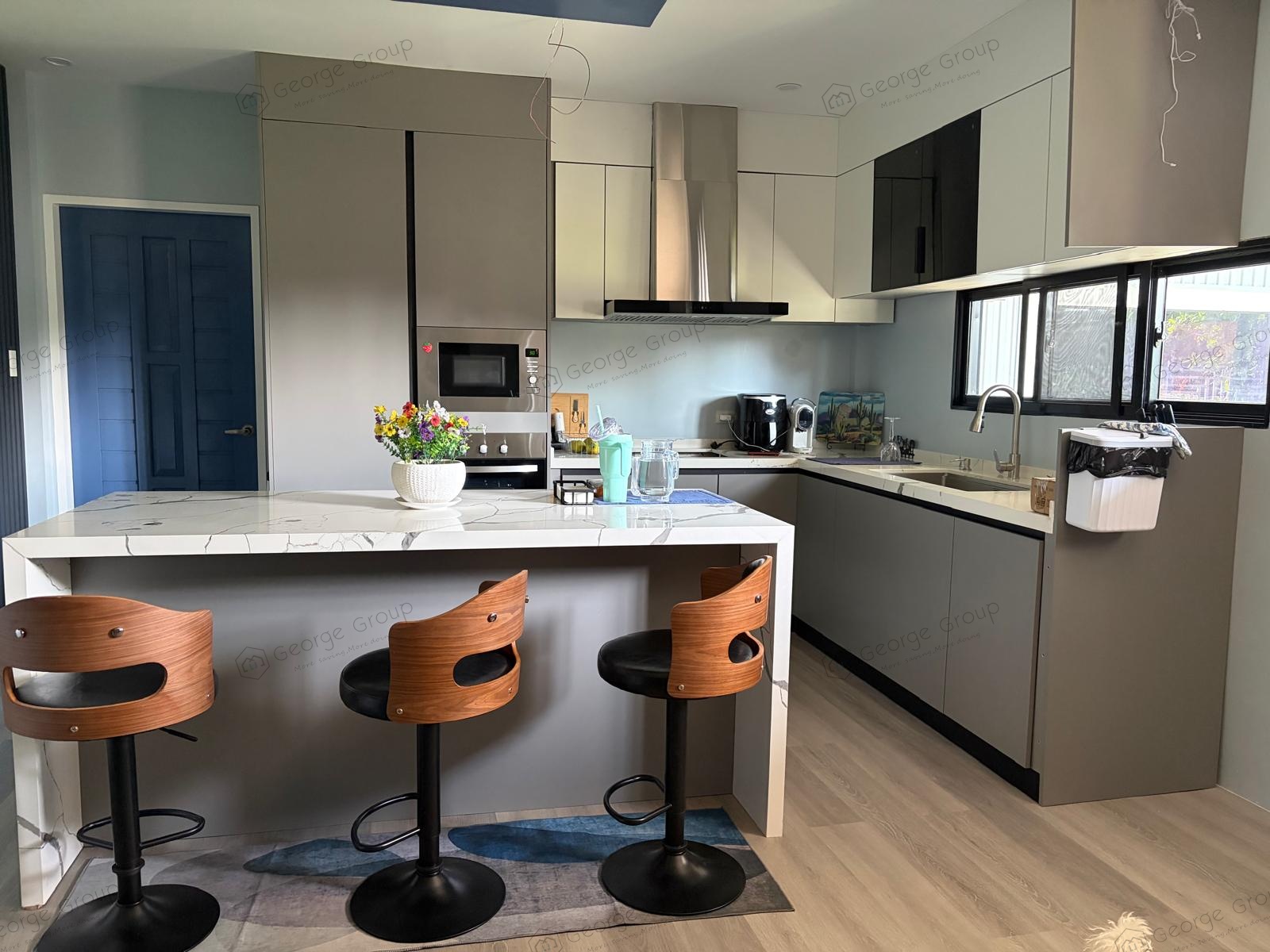
A YoloDeco residential kitchen project in the United States, supplied with custom cabinetry and coordinated finishes.
Watch the Cabinet Measurement Method
Cabinets and wardrobes may be priced by projected area or by expanded panel area. Projected area uses the cabinet's width multiplied by height, which is simple but can hide differences in internal structure. Expanded panel area calculates the actual panels used, which is more detailed but harder to compare without a drawing.
Neither method is automatically better. The risk is comparing one supplier's projected-area price with another supplier's expanded-area price. Ask which method is used, what the standard internal configuration includes, and how shelves, drawers, and special hardware change the price.
Put Every Quote on the Same Basis
Do not compare a factory price with a delivered price. Decide which cost boundary you want to evaluate, then ask every supplier to quote to that boundary.
EXW or FOB comparison
- Useful when you have your own forwarder.
- Separate product price, export packaging, and local handling.
- Confirm who pays origin charges and documentation.
- Add freight, insurance, duty, tax, and delivery separately.
DDP or delivered comparison
- Useful when you want one landed cost.
- Confirm the delivery address and access conditions.
- Ask whether duty, tax, unloading, and upstairs delivery are included.
- Clarify what happens if customs or site requirements change.
For a real project budget, use a landed-cost view rather than a product-only view:
If a supplier cannot price an item yet, mark it as pending rather than treating it as zero. A lower quote with several pending items is not necessarily a lower project cost.
Want the same coordinated solution for your project? Send your drawings or an existing quote, and get a free consultation with our team.
WhatsApp UsLock QC Checkpoints Before Production
Quality control is most useful before the goods are packed. Once a container is loaded, correcting a wrong finish, size, or missing accessory becomes much more expensive.
For a whole-house order, we recommend four checkpoints:
- Drawing approval: confirm dimensions, room layout, opening direction, panel division, and accessory locations before production.
- Sample or finish approval: approve the actual board, color, edge banding, door finish, and hardware range rather than relying only on a render.
- In-production and pre-packing inspection: check sizes, finish consistency, hardware, quantity, labeling, and packaging. For larger orders, agree whether inspection uses AQL sampling and which inspection level applies.
- Loading check: confirm cartons, pallets, item labels, loading sequence, and the final packing list against the order.
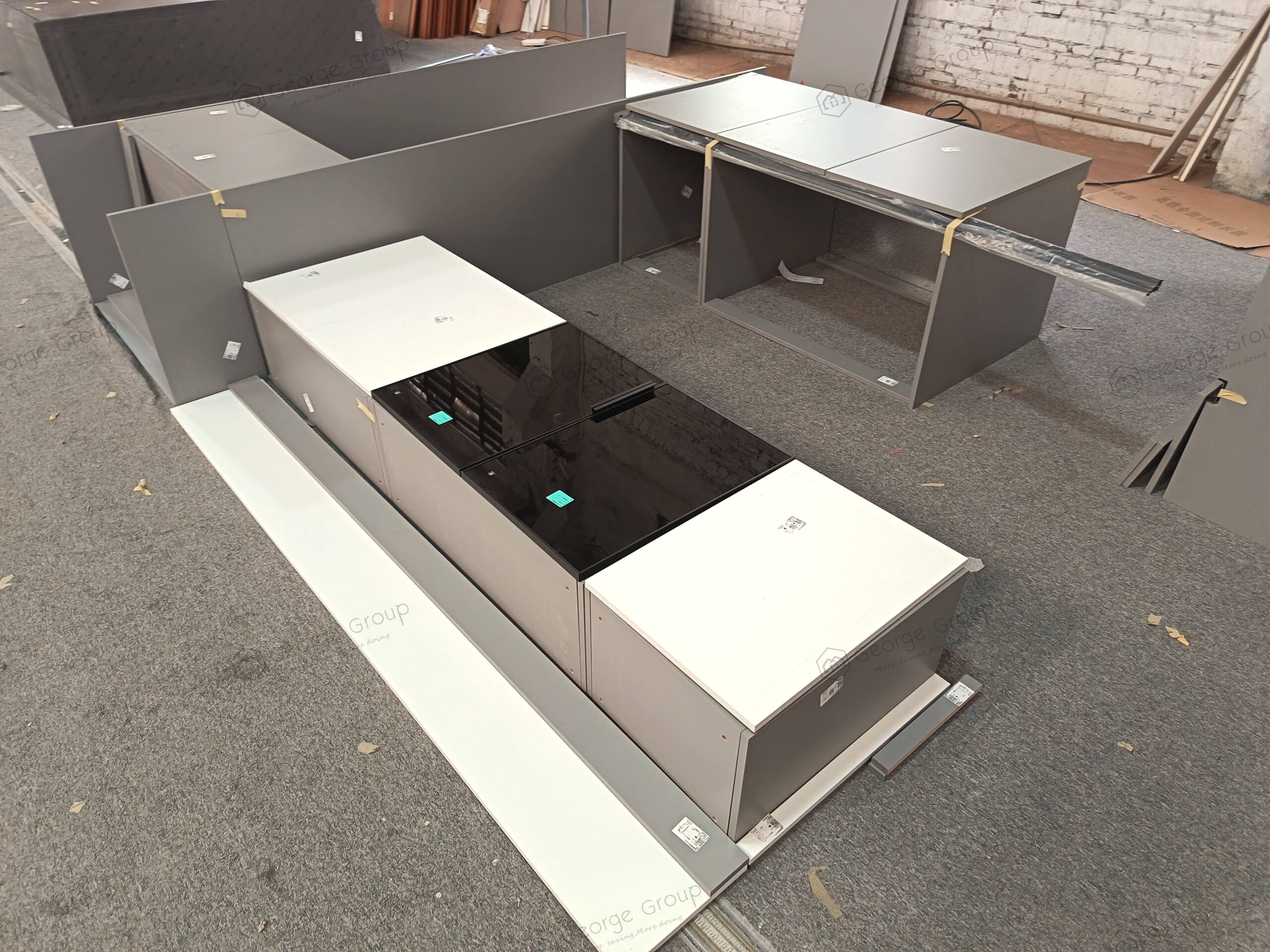
Cabinet carcasses checked in the workshop before packing for a US project.
Put these checkpoints in the Proforma Invoice or Sales Confirmation. State which drawings and samples are the approved reference, how inspection results will be shared, and what happens if a product does not match the approved specification. If a third-party inspector is involved, ask for the report to reference the order or batch number so the results can be traced to your shipment.
Verify Certifications for Your Destination
Compliance is not a marketing badge. It is a shipment and project requirement that depends on the destination, product material, and local import rules. Ask for documents that match the actual product and production batch, not a generic certificate image.
| Destination or scope | Common requirement to discuss | What to verify |
|---|---|---|
| United States | CARB Phase 2 / TSCA Title VI for composite wood products | Test report scope, product model, supplier name, and batch or lot reference |
| European Union | E1 emission class; ENF where a lower-emission specification is required | Emission report and the exact board or product range covered |
| Japan | F☆☆☆☆ where specified | Applicable JIS/JAS documentation for the supplied material |
| Saudi Arabia and other regulated markets | SASO/SABER or local shipment certification | Which party obtains certification and when it is issued |
| Solid wood packaging | ISPM 15 / IPPC treatment where required | Treatment mark on pallets or crates, not only a statement in the quote |
| Timber sourcing claims | FSC chain of custody where claimed | Certificate scope and whether the claim applies to the ordered products |
Two checks matter more than the logo on a certificate. First, confirm that the document covers the same board, finish, and product category as your order. Second, ask how the document links to the production batch. A sample tested to one emission level does not prove that every later production run uses the same material.
Where preferential tariffs apply, certificates of origin such as FORM E or ChAFTA may reduce duty. Arrange the document before shipment and confirm the timing with your forwarder; a certificate requested after arrival may not recover the expected saving.
Plan the Production and Delivery Timeline
A multi-category order moves at the speed of its slowest custom item. Tiles or lighting may be ready earlier, but the container cannot close until the cabinets, doors, or other made-to-order items have passed inspection.
Build the schedule backwards from the required arrival date:
- Drawing and specification freeze: set the date after which sizes, finishes, and quantities cannot change without a written variation.
- Production: for George Group custom cabinetry, the standard production window is 35–45 days after drawing confirmation. Confirm the lead time for every other category separately.
- Inspection and remedial work: leave time to correct shortages, finish issues, or packing problems before the container is booked.
- Consolidation and loading: coordinate all categories into one packing list and loading plan.
- Freight and customs: use your forwarder's route-specific estimate rather than a generic transit promise.
Ask each supplier which item is on the critical path and what happens if you approve drawings late. A delivery date that does not start from drawing approval is not a usable project date.
How YoloDeco Handles a Multi-Category Project
For whole-house projects, we coordinate custom production and sourced products through one project workflow. The exact scope depends on the buyer's drawings and product list, but the working sequence is consistent:
- Review floor plans, room schedules, and reference images.
- Prepare 3D design and shop drawings for custom items.
- Build a category-by-category quotation with specifications and exclusions.
- Confirm finishes, hardware, sizes, and packaging before production.
- Inspect products and share QC records before shipment.
- Coordinate packing and container loading across categories.
Project example: apartment procurement in Tanzania
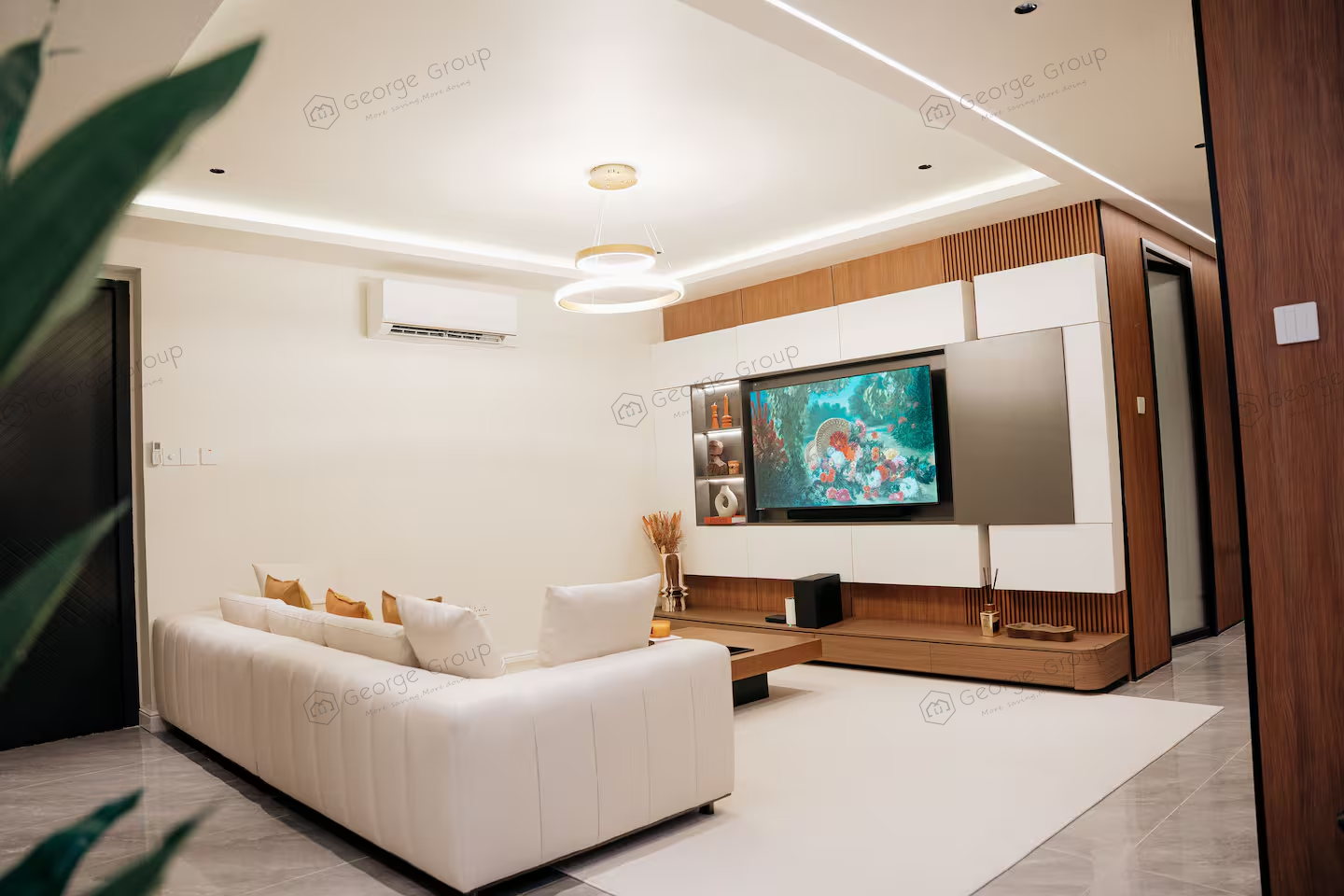
Custom living-room joinery, wall panelling, and matching interior doors from the Tanzania apartment project.
For an apartment project in Dar es Salaam, Tanzania, the supply package covered tiles, doors and windows, sanitary ware, cabinetry, furniture, lighting, and wall panels. Each category was quoted and tracked separately, while the overall project was coordinated through one supply workflow.
The quotation separated categories so the buyer could review quantities and specifications by product type. Payment was arranged in stages, with a deposit after confirmation and the balance before loading. Packaging varied by product, including cartons and palletized protection where required.
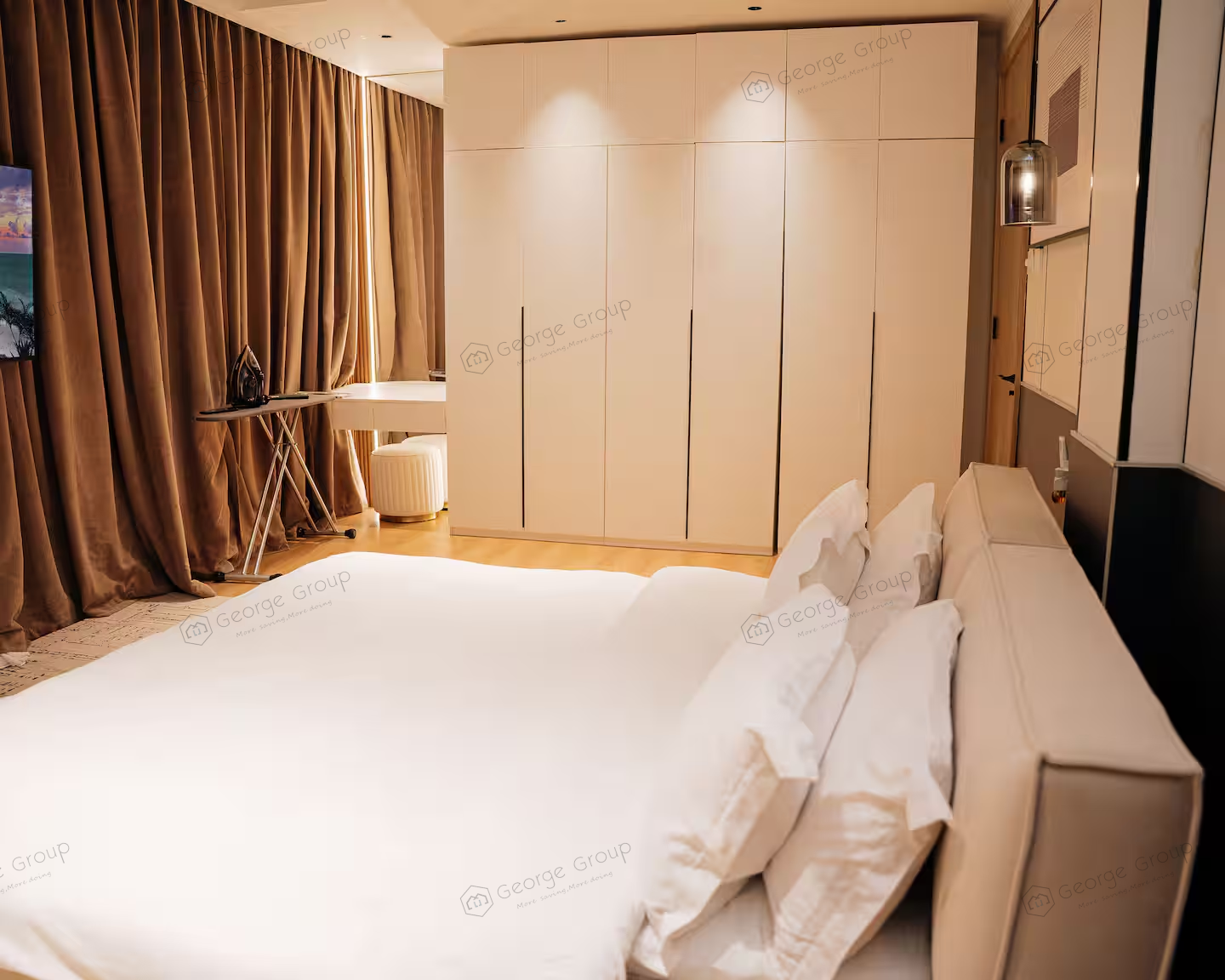
Floor-to-ceiling wardrobe with integrated desk from the same apartment project.
What this means for a buyer: a one-stop supplier should still give you category-level visibility. Consolidation should reduce coordination work, not hide specifications, quantities, or inspection records.
For another residential project in Australia, the quotation included a delivered shipping option for a 20GP container. This illustrates why trade terms matter: an EXW product quote and a DDP project quote answer different budgeting questions. When comparing suppliers, make sure the delivery boundary is the same.
Where Whole-House Projects Go Wrong
Project-side risks
- Design and quote are not synchronized. The render shows upgraded finishes or accessories that are not in the priced specification.
- Quantities are estimated too early. Final measurements change cabinet lengths, tile quantities, door sizes, and accessory counts.
- Different categories arrive on different timelines. Production and consolidation need to be planned around the slowest custom item.
- Installation responsibility is assumed. Material supply does not automatically include local installation, plumbing, electrical work, or site modification.
- Inspection is left until arrival. Pre-shipment inspection is usually the last practical point to correct errors.
Supplier-side risks
- The seller is a shell intermediary. A polished website does not prove control of production, QC, or the factory's delivery schedule.
- The price changes after the deposit. Unclear specifications make it easy to reclassify standard items as upgrades.
- Materials are substituted. The approved sample and the production batch may not use the same board, finish, or hardware.
- Customs values are manipulated. Under-declared HS values can create clearance, penalty, and insurance problems for the buyer.
- Drawings are reused. If design confidentiality matters, agree on document use and confidentiality before sending the full package.
Terms to Lock in the Proforma Invoice
The Proforma Invoice or Sales Confirmation should do more than repeat the price. It should define what happens when the project does not go to plan.
- Approved references: drawing version, finish sample, hardware range, and specification sheet.
- Lead time: the event that starts production, the promised completion window, and the remedy for supplier-caused delay.
- Inspection rights: who inspects, at which stage, and whether shipment requires buyer approval of the inspection result.
- Defect remedy: replacement, repair, credit, or refund for shortages and specification mismatches.
- Warranty split: separate terms for cabinet structure, hardware, and surface finish rather than one vague warranty line.
- Spare parts: touch-up materials, spare hardware, and replacement panels where appropriate.
- Change control: how variations are priced and the cut-off date for changes.
- Payment stages: link each payment to a deliverable such as drawing approval, inspection, or loading.
- Shipping documents: packing list, bill of lading instructions, and who controls document release.
- Dispute handling: governing terms and the process for resolving a disagreement.
Supplier Checklist Before You Pay a Deposit
Use this list with every supplier
- Itemized quotation by room and product category
- Material, finish, hardware, and dimension specifications
- Cabinet measurement method and standard internal configuration
- Clear list of accessories and exclusions
- Destination-specific certification and batch-linked test reports
- Origin-certificate and wood-packaging requirements where applicable
- Packaging method and export protection
- Trade term and exact delivery boundary
- Critical-path item and production lead time starting from drawing approval
- Drawing, sample, inspection, and loading checkpoints
- PI terms for delay, defects, warranty, spare parts, and changes
- Payment stages and what triggers each payment
- Process for handling shortages, damage, or specification mismatches
- One coordinated contact for production, QC, and shipment updates
Send Your Drawings or Existing Quote
We can review your room list, identify missing scope, and prepare an itemized whole-house quotation. If you already have another supplier's quote, send it with the specification so we can help you compare like for like.
WhatsApp UsFAQ
How much does whole-house customization from China cost?
There is no reliable fixed price per project. Cost depends on room count, cabinet dimensions, board and finish specification, hardware, quantities, packaging, and delivery terms. The useful approach is to compare itemized quotations on the same specification and then add freight, duty, tax, delivery, and installation to reach a landed project cost.
What should I send to get a whole-house customization quote?
Send floor plans or measurements, a room-by-room product list, reference finishes, quantities where available, and your destination port or delivery address. If you do not have complete drawings, start with the rooms and product categories you need.
Can different product categories be shipped together?
Yes, when production schedules, packaging, and container space are coordinated. Custom items and sourced items may have different lead times, so the shipment plan should be confirmed before production starts.
Are samples available?
Most small samples are usually free; you only need to pay for shipping.
Is local installation included?
Not by default. Installation, site modification, plumbing, and electrical work should be listed explicitly if they are part of the scope. Otherwise, assume the quotation covers product supply and the agreed delivery term only.