China Kitchen Design 2026: From Chinese Factories to Your Kitchen
For overseas buyers, China kitchen design in 2026 means export-grade custom kitchens — designed with you remotely, built in Chinese factories to Western dimensions and safety standards, and delivered to your project site. It is not about “cheap cabinets”; it is about getting made-to-order design and manufacturing on a lower cost base than local custom shops.
This route fits homeowners, developers and contractors who plan months ahead — whether for one home or a hundred units. It is a poor fit if you need cabinets this week, want to see samples in a local showroom first, or only need a single off-the-shelf cabinet.
This guide covers the 2026 styles Chinese factories actually build, what drives the cost, and how the remote design process works from floor plan to shop drawings.
Planning a kitchen project from China?
Our buying guide walks through the full process — design service, 3D drawings, samples, production, quality checks and shipping — and what to prepare before you ask for a quote.
Read: Buying Kitchen Cabinets from China — The Complete Guide
What Is True China Kitchen Design for Overseas Markets?
Authentic Chinese kitchen design is not merely about “cheap cabinets from China.” It is a comprehensive system that integrates China’s exceptional manufacturing craftsmanship, Western ergonomics, specific safety standards from various countries, and unique lifestyle requirements.
For overseas buyers, it addresses their biggest pain points: high local prices, long lead times, and uncertainty regarding quality. Chinese factories produce on a lower cost base while meeting export standards — but the real saving depends on specification, order size and freight, so compare landed cost rather than headline prices.
What Does Modern Chinese Kitchen Design Look Like?
For overseas buyers, “Chinese kitchen design” in 2026 covers two things: the styles Chinese manufacturers build for homes at home, and the export-grade versions they produce for projects abroad. The practical takeaway is that Chinese factories now work in the same contemporary styles seen in North American and European kitchens — flat panel, warm neutrals, natural wood — and can reproduce them on a lower cost base.
Layout: Compact, Efficient, Storage-First
Urban Chinese homes typically have smaller kitchens than Western ones, so domestic design has evolved around efficiency: L-shaped and single-wall layouts, full-height cabinetry that runs to the ceiling, and a high density of drawers and pull-out organizers per square meter. For overseas projects, manufacturers adapt these compact-planning habits to open-plan and island layouts — the same supply chain produces both.
Materials and Colors
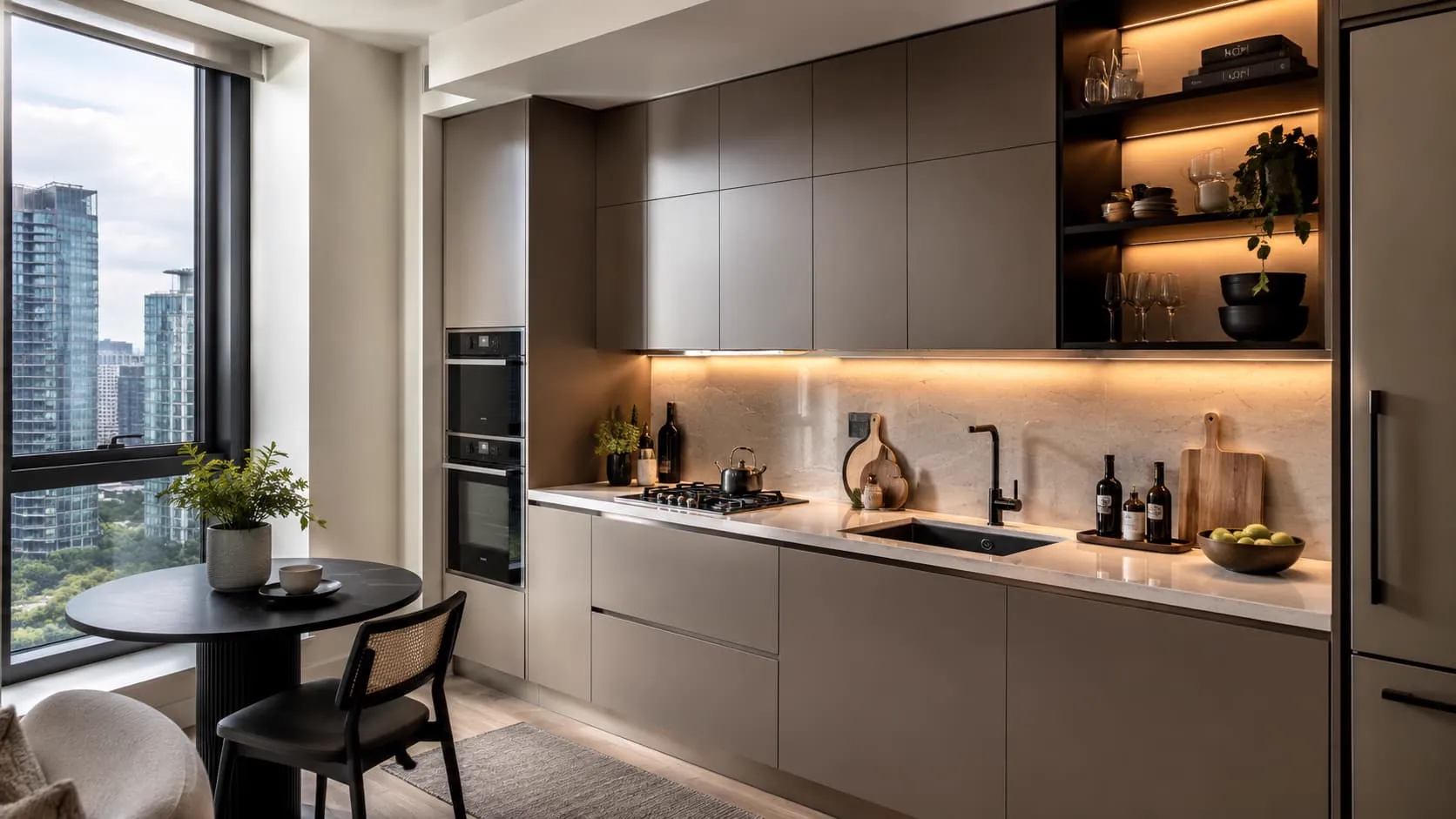
The mainstream look in 2026 is flat panel kitchen cabinets in matte finishes, with warm neutrals such as greige and natural wood tones like white oak replacing the high-gloss styles of a decade ago. PET and melamine surfaces dominate mid-range projects, while veneer and solid wood cover the high end.
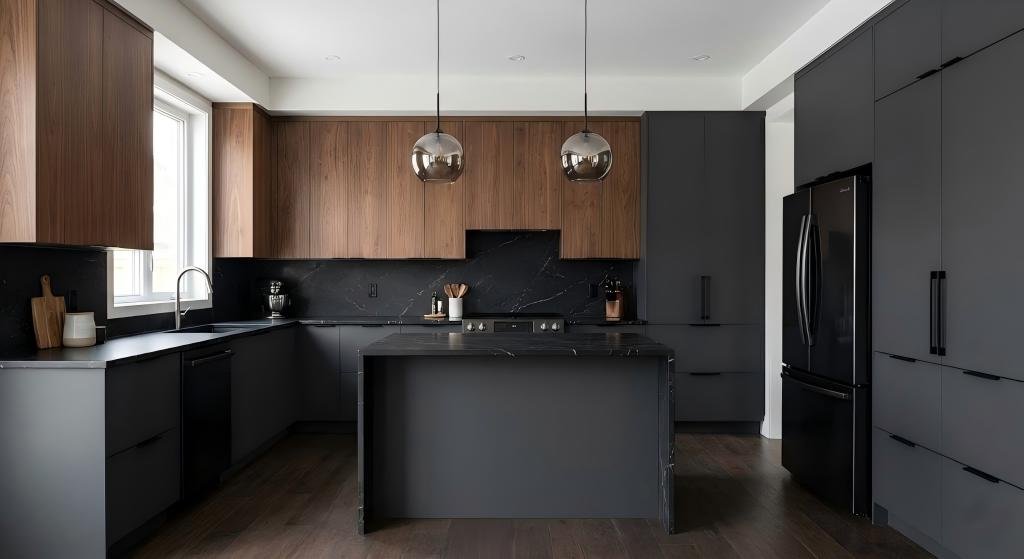
A two-tone flat panel kitchen produced in Foshan — a style Chinese factories now manufacture for both domestic and overseas homes. See real installations in the case studies below.
How Much Do Kitchen Cabinets from China Cost?
The cost of kitchen cabinets from China varies depending on customization level, materials, and project complexity. In general, China offers a more competitive price compared to local markets.
Estimated Price Range
| Cabinet Type | Price (Per Linear Foot) | Best For |
|---|---|---|
Stock Cabinets |
$100 – $250 |
Budget projects, standard layouts |
Semi-Custom Cabinets |
$200 – $500 |
Most residential kitchens |
Fully Custom Cabinets |
$400 – $1,000+ |
High-end or complex designs |
In many cases, even after including shipping and import costs, total expenses are still 40% lower than local suppliers in North America or Europe.
For a detailed breakdown by material, door style, and project size, see our custom kitchen cabinet cost guide.
What Affects the Cost?
- Material: MDF, plywood, or solid wood significantly impact pricing
- Hardware: Hinges, drawer systems, and brand selection
- Finish: Painted, laminate, or veneer surfaces
- Logistics: Shipping distance, container size, and delivery method
However, price alone does not determine whether it is the right choice — understanding both the advantages and limitations is equally important.
Pros and Cons of China Kitchen Cabinets
Choosing kitchen cabinets from China can offer clear benefits, but it also comes with certain considerations.
Pros
- Cost efficiency
- Customization flexibility
- Wide material options
Cons
- Longer delivery timeline (6–10 weeks)
- Requires coordination with overseas suppliers
- Installation handled locally
Why Do Developers Prefer the Chinese Kitchen Supply Chain?
An increasing number of overseas builders and developers are choosing to work directly with China’s kitchen supply chain, primarily due to the following key advantages:
- Cost-Effectiveness: With large-scale production lines and well-established industrial clusters, Chinese factories can provide highly cost-effective solutions that enhance overall quality while staying within budget.
- Material Diversity and High Quality: Thanks to China’s robust supply chain, Chinese factories can easily source and process a wide variety of high-grade materials.
- Highly Flexible Customization Capabilities: China’s supply chain supports in-depth and flexible customization services. Whether it’s color or design style, precise customization is possible.
- Reliable Delivery Assurance: Thanks to digital manufacturing technologies that have matured by 2026, production cycles have become more predictable. The entire product manufacturing process can be digitally tracked.
- Service-Oriented Business Support: Experienced service providers typically offer high-quality services, assisting clients with needs and product analysis, and providing professional technical solutions.
The YOLO Service Model: A Fully Guided Kitchen Project
At YoloDeco, leveraging China’s high-quality supply chain, we’ve developed a guided overseas service model. A typical custom kitchen project runs about 10–16 weeks from first consultation to delivery — here is what happens at each step and what we need from you:
- Free Consultation (week 1) — We review your floor plan, lifestyle, and budget to match you with suitable products. You provide room measurements or architectural drawings.
- 2D & 3D Design (weeks 1–3) — Our designers create 3D renderings with the exact materials and layout you choose, with free revisions until you’re satisfied.
- Sampling & Confirmation (weeks 3–5) — Material samples, finish references, and hardware are confirmed in writing before production starts, so there are no surprises later.
- Factory Production (weeks 5–11) — Production takes place in our own factories with full traceability and quality control at each stage; you receive progress updates and pre-shipment photos or videos.
- End-to-End Logistics (4–6 weeks by sea) — We arrange sea or air freight with real-time tracking from the moment your products leave the factory. Sea freight is the largest schedule variable.
- Delivery and Remote Guidance — Room-by-room labeled packaging, detailed video installation tutorials, and after-sales support for your installation team.
All of this is backed by YoloDeco’s brand commitment: factory certification, product warranties, and a fully traceable system.
What are some high-quality China Kitchen Design options for 2026?
Based on the latest data from the NKBA 2026 Kitchen Trends Report , styles ordered by overseas buyers from Chinese factories are mainly concentrated in these three categories:
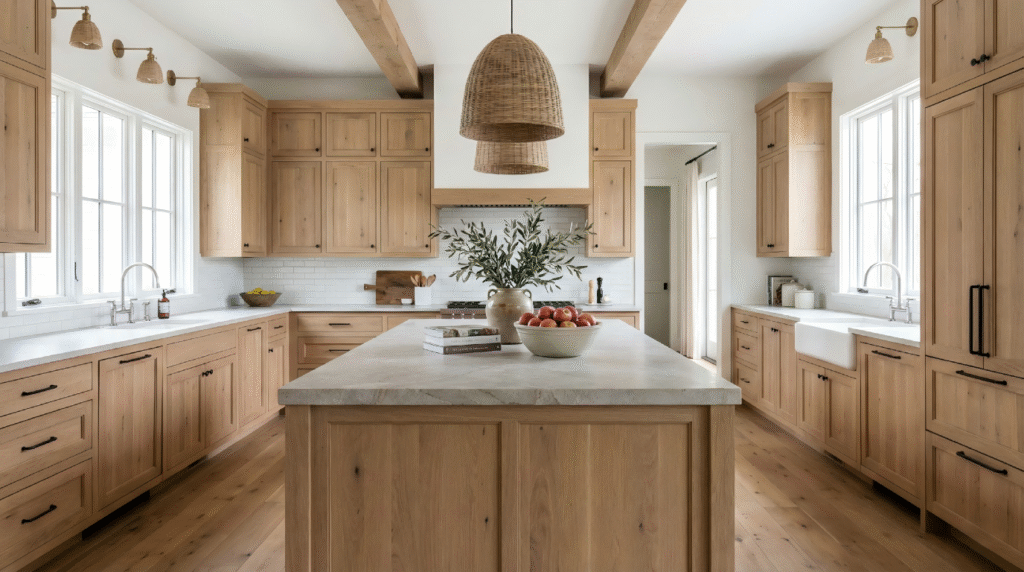
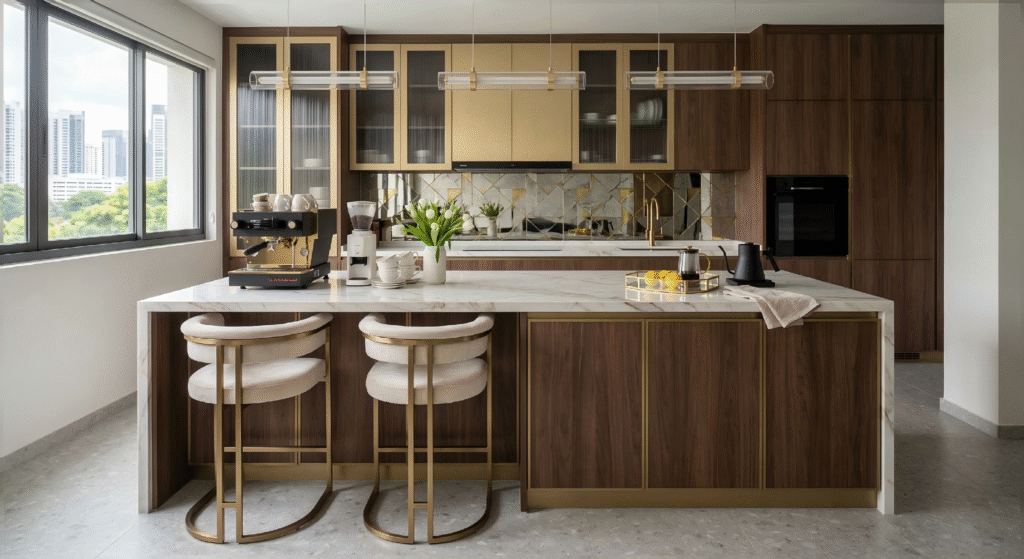
- Modern Country: Approximately 59% of surveyed designers noted that market demand for cabinets featuring natural wood grain is growing. Some of my overseas clients frequently order cabinet doors in white oak, maple, or walnut. These options ensure cabinet quality while maintaining a natural aesthetic.
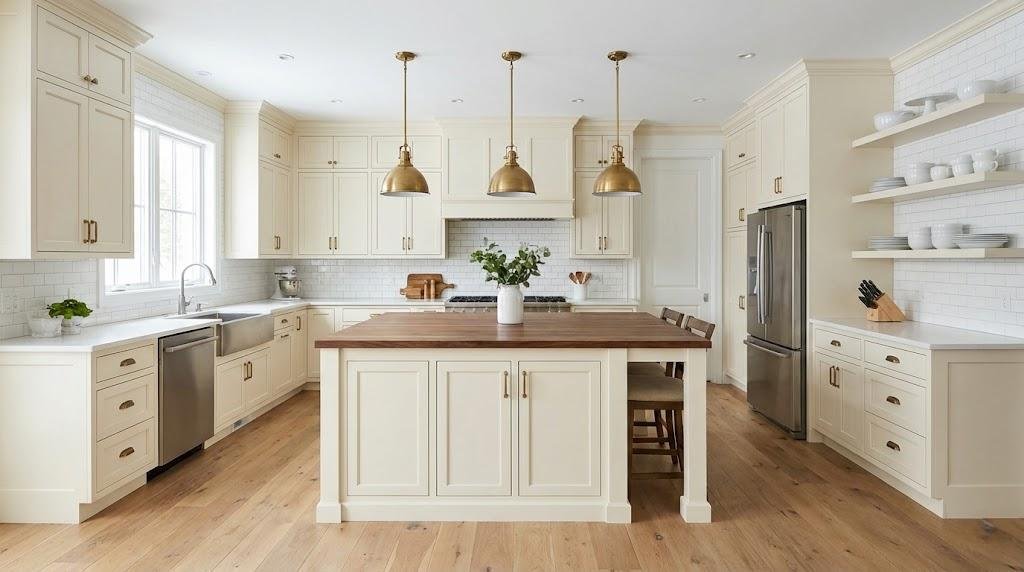
- Warm Minimalist Style: The popularity of all-white kitchens is gradually declining, being replaced by flat-panel cabinets in cream or grayish-beige tones with high light reflectivity.
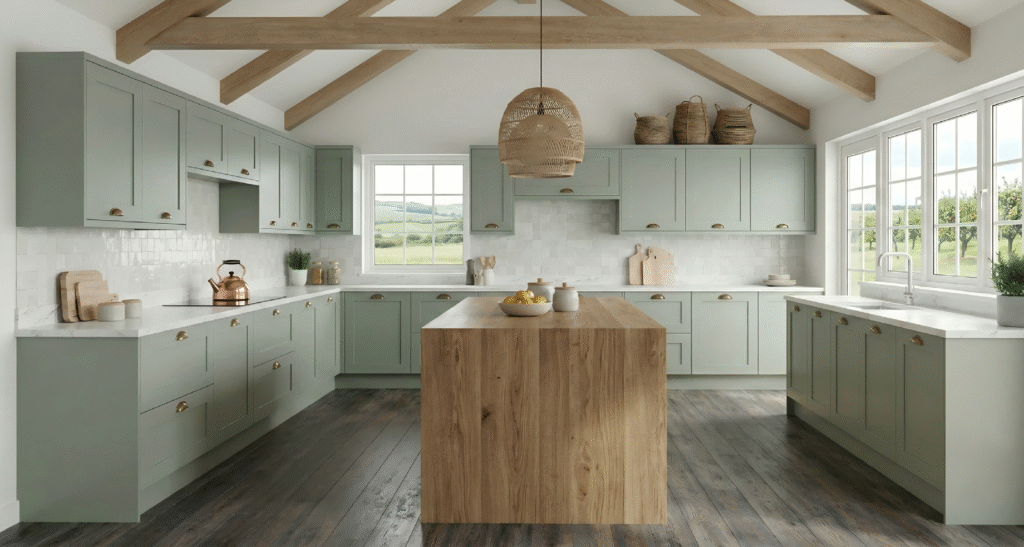
- Transitional Farmhouse Style: Shaker-style cabinet doors in the Morandi color palette (such as deep sage green), paired with vintage hardware, remain a solid choice in the North American market.
YOLO's Exclusive Overseas Case Studies
In YOLO’s workflow, “what you see is what you get” is a core principle.
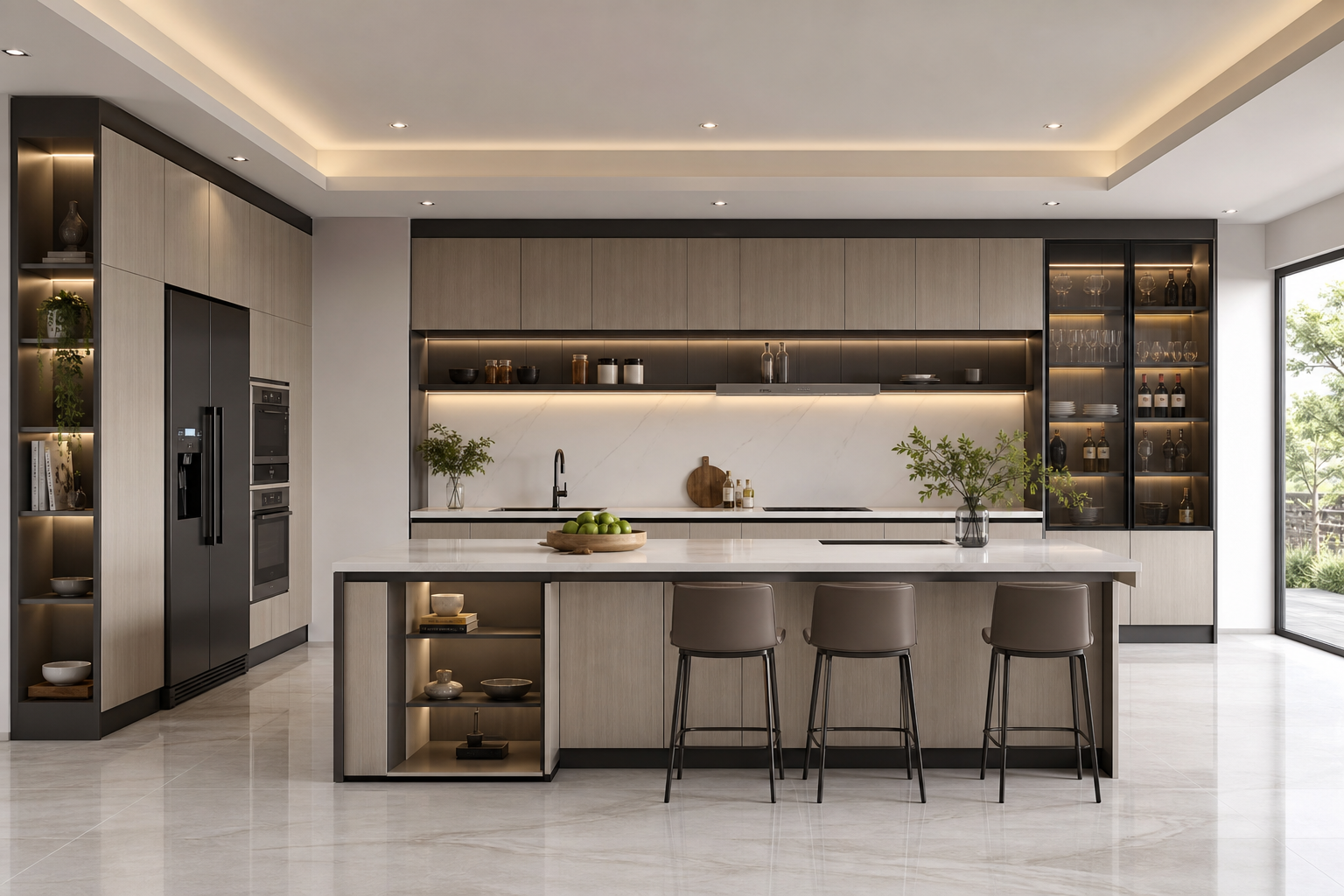
- In this 3D preview, clients can intuitively visualize the villa’s kitchen in three dimensions. From the light reflecting off the taupe cabinets to the texture of the marble island countertop produced at YOLO’s in-house stone factory, every detail is customized and confirmed before production begins. This visual approach to communication significantly reduces miscommunication during the cross-border customization process.
Essential Tips to Avoid Pitfalls in China Kitchen Design
Designing kitchens for international residential projects is more than just a matter of production. Every country has its own unique building codes, electrical requirements, and environmental conditions, all of which must be carefully considered during the design process. For overseas kitchen projects, professional suppliers must adapt the kitchen systems to meet the specific needs of each homeowner.
- Local Building Standards:Cabinet materials and installation must comply with local safety and environmental regulations.
- Climate Adaptation:Different climates require moisture-resistant panels and stable cabinet structures.
- Electrical Planning:Appliance layouts and power outlets must be planned during the design stage.
- Hardware Selection:High-quality soft-close hinges and drawer systems ensure durability and smooth operation.
FAQ
A: This depends on the type of local service you are comparing it to. Compared to “in-stock standard cabinets” from a local retailer, cross-border customization does require additional ocean freight time (typically 30-45 days to North America or Europe). However, if you compare it to local “fully custom cabinets” (which often require a 6-10 week production period), the overall delivery timeline is actually quite similar. We recommend planning your project schedule 2 to 3 months in advance.
A: Yes. One of the core strengths of the Chinese supply chain is its extensive material accessibility. Whether you need natural marble with unique veining, premium wood veneers, or specialized liquid metal finishes, the YOLO team can source and process these materials utilizing our industrial cluster resources in Foshan.
A: Cross-border customization generally does not include direct overseas on-site installation. To simplify the process, YOLO conducts pre-assembly tests on complex cabinets before they leave the factory to ensure accurate pre-drilled holes. Deliveries include standardized English installation manuals, clear part numbering labels, and detailed remote video guidance to help your local carpentry team assemble the kitchen smoothly.
A: YOLO is a specialized international team operating under the George Group. We manage physical production lines and matching stone processing facilities in Foshan, China. We support live video calls for “virtual factory tours” at any time. Before collaboration, we also provide relevant factory credentials, export records, and material test reports (such as SGS environmental testing) for your verification.
A: A typical project runs 10–16 weeks from first consultation to delivery: design 1–3 weeks, sampling and confirmation about 2 weeks, production 4–8 weeks depending on materials and order size, and ocean freight 4–6 weeks to North America or Europe. Air freight is an option for urgent small batches such as hardware or replacement parts.
A: Every order goes through pre-shipment inspection with photos and videos for your confirmation before loading. Cabinets are packed with room-by-room labels matching the layout drawings, which reduces installation errors. If something arrives damaged, we produce and ship replacement parts; if a dimension is disputed, we check it against the signed-off drawings to determine responsibility before remediation.