Navy Blue Kitchen Cabinets: The Complete Design Guide
Navy blue kitchen cabinets can create a visually layered look and give the kitchen a calm, elegant feel. The real question isn’t whether “navy blue looks good,” but whether it fits your lighting, floor plan, budget, countertop material, and daily habits.
This article will answer the questions users most often ask: Is navy blue still trendy? What wall colors and countertops go well with it? How should you choose hardware? Is it a good choice for small kitchens? What budget should you plan for? Are dark cabinets hard to maintain? And what common mistakes should you avoid before renovating?
Are Navy Blue Kitchen Cabinets Still in Style?
- Navy blue strikes a stylish balance in design. It is softer than black and more elegant than sky blue, and it is surprisingly adaptable across many design styles. Whether your kitchen is modern, traditional, rustic, coastal, or another style, navy blue fits in perfectly.
- Unlike trendy colors that fade out of fashion after a few years, navy blue has a design history that spans hundreds of years. Similar to charcoal gray, it works as a neutral—deep enough to ground a space while maintaining enough color. This is exactly why it consistently holds its value in the resale market. It projects a sense of sophistication in design without discouraging potential buyers.
Pros of Navy Blue Kitchen Cabinets
- They create a high-end, custom look.
- They pair beautifully with white, cream, gray, wood, brass, nickel, and stainless steel.
- They add personality without using a bright or risky color.
- They work well as full cabinetry, lower cabinets, or an island accent.
- They can make builder-grade cabinets feel more intentional.
Cons to Consider
- Dark cabinet doors show dust, fingerprints, grease, and water marks more easily.
- Chips and scratches are more visible than they are on light cabinets.
- Small or low-light kitchens can feel heavy if navy is overused.
- Paint touch-ups must match the exact color and sheen.
- Navy undertones can shift dramatically under warm or cool lighting.
The Best Colors, Countertops, and Backsplashes to Pair With Navy Cabinets
Getting the pairings right is where navy kitchens succeed or fall flat. The key concept to understand first: navy blue isn’t one color. Some navy shades pull green (think Hale Navy); others lean purple or almost black (like Naval). Your undertone determines everything about what works alongside it.
Wall Colors
| Wall Color | Best With | Avoid |
|---|---|---|
Warm white (BM White Dove, SW Alabaster) |
Green-leaning navy, wood accents |
Purple-toned navy |
Cool white (BM Chantilly Lace) |
Ink or purple-navy, gray stone counters |
Warm butcher block |
Soft gray / greige |
Most navy shades |
Very warm kitchens — can feel cold |
Sage green |
Green-leaning navy |
Blue-dominant navy (too much green) |
Taupe |
Warmer, traditional navy |
Modern or coastal styles |
For smaller kitchens, light-colored walls—such as warm white or soft beige—are often the best choice. They help the space feel more open without taking away from the visual impact of navy blue cabinets.
Countertops
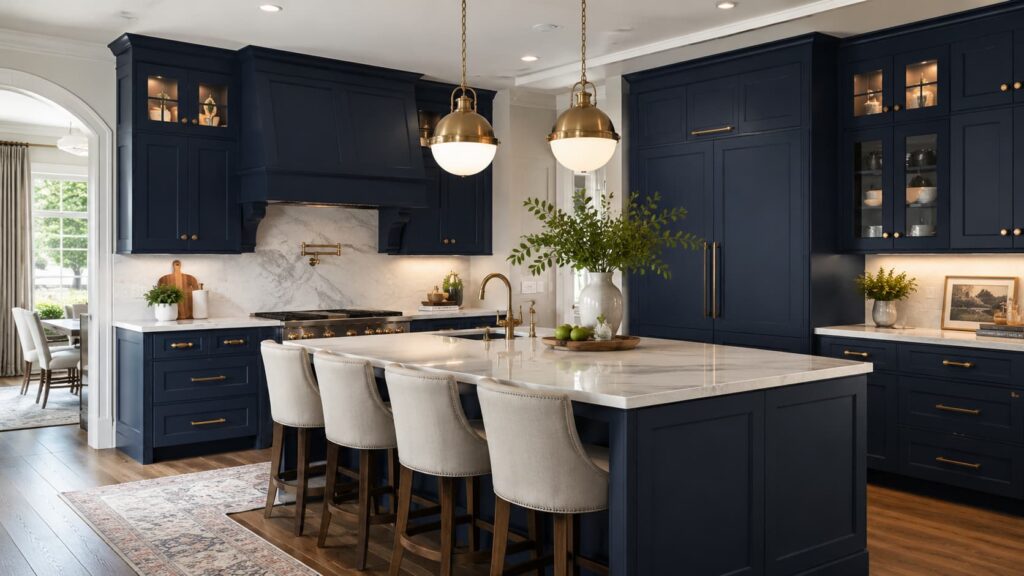
- White quartz or marble-look stone is the most popular choice. When paired together, they create a striking contrast and reflect light into the space—an advantage for dark cabinets.
- Solid wood countertops provide a warm, natural feel that softens the formality of navy blue. They are perfect for farmhouse- and transitional-style kitchens and look their best when paired with navy blue with a greenish undertone.
- Gray stone or concrete-look quartz is perfect for minimalist kitchens. A monochromatic palette of navy blue and gray looks elegant, but it needs warm accents. For example, brass hardware or wooden cutting boards can help prevent a cold, sterile feel.
- Choose black granite carefully. When combined with navy blue, it can make a space feel heavy. Use it only in kitchens with plenty of natural light where you’re going for a distinctive look.
Backsplash
- White subway tile — safe, clean, timeless. It lets the cabinets be the focal point without competing.
- Zellige tile — adds warmth and texture, looks especially beautiful with brass hardware.
- Marble slab or large-format stone behind the range creates a sleek, upscale look.
- Warm neutral tile in a handmade or tumbled finish — bridges nWarm neutral tile with a handmade or tumbled finish — connects navy with wood accents. avy with wood accents.
- Pattern tile (cement or encaustic) — can be stunning, but requires careful colour coordination.
Flooring
Light oak or white oak flooring is the most dependable choice to balance navy blue cabinets. These materials add warm tones to the space and help prevent the lower half of the kitchen from seeming too heavy. Light-colored stone tiles, warm white or greige large-format tiles, or even painted concrete floors all work well here. However, dark flooring paired with navy blue cabinets needs plenty of natural light and a lighter upper half to balance the overall look.
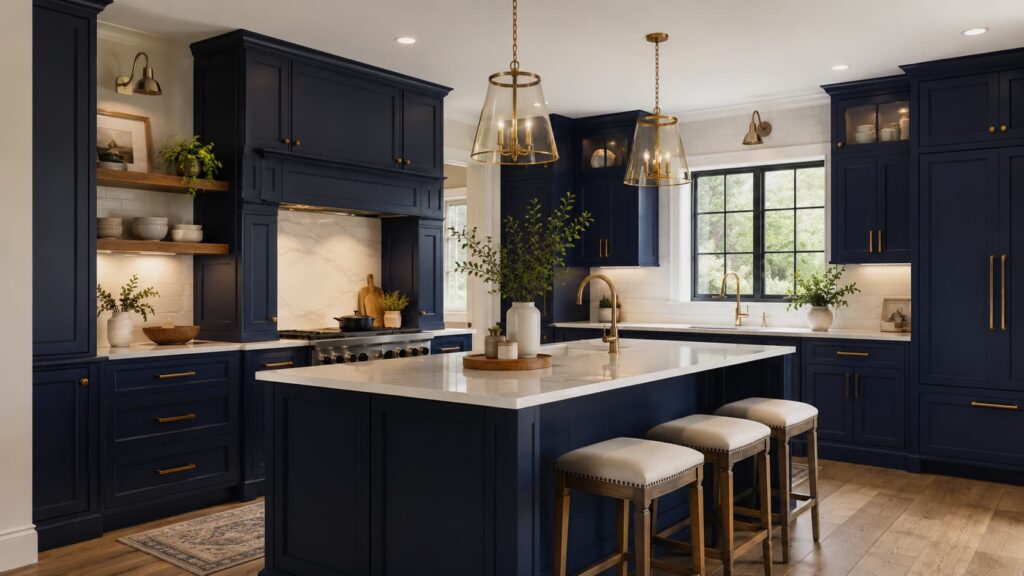
Hardware, Appliance, and Finish Ideas for Navy Blue Cabinets
Hardware may seem like a small decision, but in a navy kitchen it carries real visual weight. Here’s how to choose with confidence.
Hardware Finishes
- Brass / satin brass is the most popular pairing with navy for good reason. The warm gold tone creates a rich, layered look that feels high-end without feeling heavy. It suits traditional, transitional, and coastal styles especially well.
- Matte black offers a modern, geometric aesthetic. It creates a striking contrast with navy blue, keeping the overall palette cool and minimalist—a perfect match for flat-panel or streamlined Shaker-style cabinet doors.
- Polished nickel is bright without being as cold as chrome. It suits classic and transitional kitchens and pairs beautifully with marble-look countertops.
- Antique bronze adds old-world charm, making it perfect for farmhouse and traditional kitchens, especially when combined with warmer, green-tinged shades of navy blue.
Appliance Finishes
Stainless steel is the safest choice—it pairs perfectly with all shades of deep blue without causing any visual conflict. Since most kitchens already have stainless steel appliances, choosing deep blue cabinets is an easy way to enhance the overall look. Built-in appliances create the most seamless appearance, allowing cabinet doors to naturally hide the dishwasher and refrigerator—this is the peak of high-end design.
Cabinet Finishes: Matte vs. Satin vs. Semi-Gloss
A matte finish looks the most elegant, but it’s also the most prone to showing fingerprints and grease stains—which can be quite challenging in a busy kitchen. A satin finish is the practical choice: it has a low sheen, is relatively easy to clean, and helps hide surface imperfections. A semi-gloss finish reflects the most light, brightening a dimly lit kitchen, but scuff marks and surface flaws will also be more visible.
Navy Cabinet Layout Ideas
How much navy you use matters as much as the shade you choose.
Full Navy Cabinets
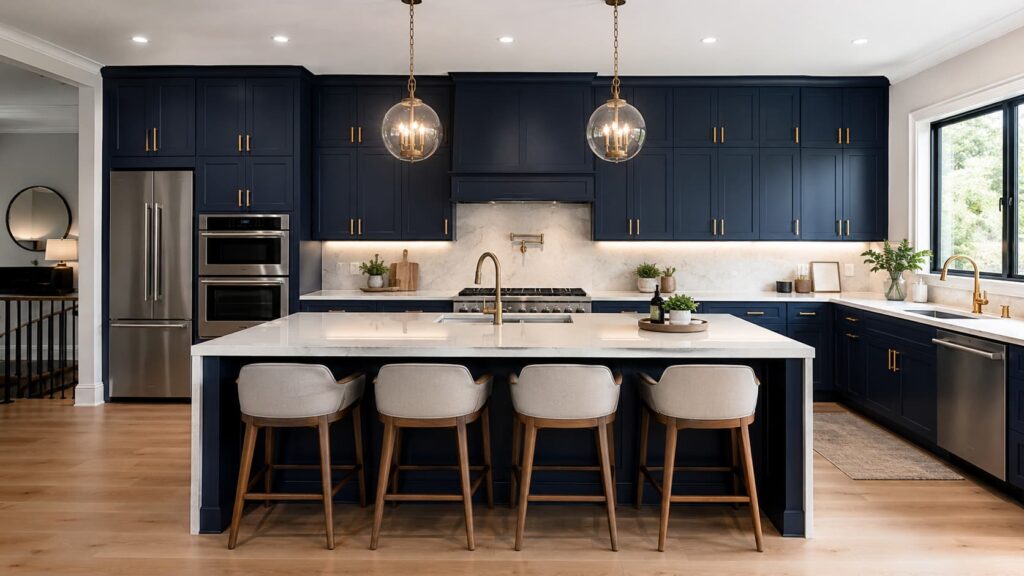
All-dark-blue cabinets are ideal for larger kitchens, open-concept homes, or brightly lit rooms. This design style is both bold and cohesive, but it should be complemented with lighter-colored accent pieces.
- Light countertops
- Light backsplash
- Warm wood floors
- Good ceiling lighting
- Under-cabinet lighting
- Glass-front cabinets or open shelves if the room feels heavy
Navy Lower Cabinets With White Uppers
This is one of the most practical ways to incorporate navy blue. The base cabinets create a sturdy foundation for the kitchen, while the white upper cabinets make the space feel open and bright.
This layout is particularly well-suited for:
- Small kitchens
- Galley kitchens
- Older homes with limited light
- Homeowners who want color without full commitment
- Budget remodels using existing upper cabinets
Navy Island Only
- A deep blue kitchen island is the simplest way to add a splash of color to a neutral-toned kitchen. It works especially well with surrounding cabinets in white, beige, gray, or natural wood tones.
- This design is particularly clever because the island looks just like a piece of furniture. Plus, if your tastes change in the future, it’s much easier to repaint.
Navy Pantry Wall or Built-In Section
If you prefer not to paint the entire kitchen navy blue, consider using it on the wall behind the pantry, the beverage station, the sideboard, or a small storage cabinet. This adds a visual focal point while keeping the rest of the kitchen bright.
Can Navy Blue Cabinets Work in a Small Kitchen?
- Yes, but you should limit the amount of dark color. The safest approach is to choose navy blue base cabinets paired with white or light-colored wall cabinets, complemented by a light-colored countertop, a reflective backsplash, and under-cabinet lighting. For the walls, we recommend warm white, light gray-beige, or soft neutral tones.
- In a small kitchen, avoid combining navy blue cabinets, dark flooring, dark countertops, and insufficient lighting. A single dark accent can add elegance, but too many dark elements can make the space feel cramped.
Popular Navy Cabinet Paint Colors
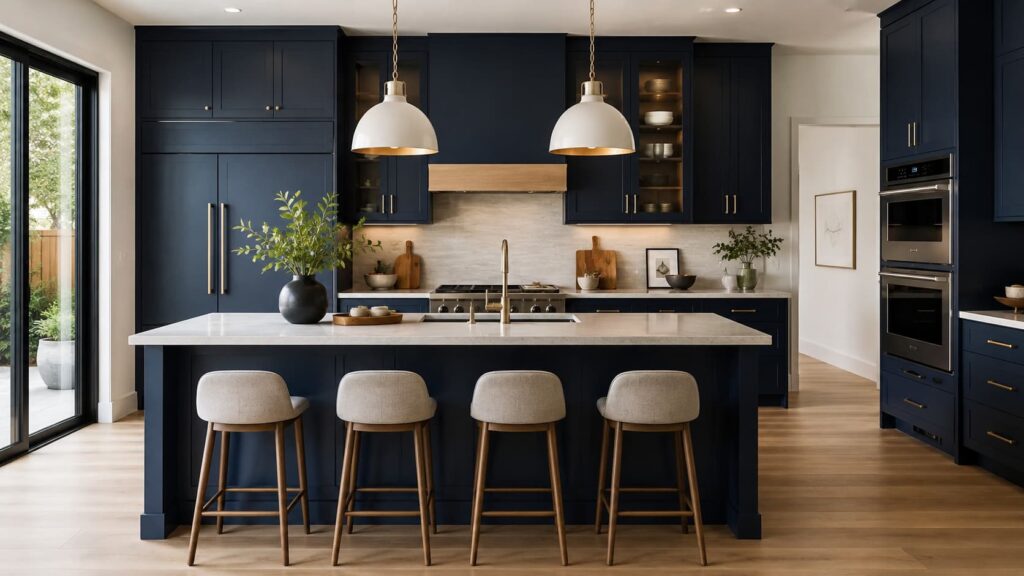
Before making your final decision, test the color in your own kitchen first. Navy blue can look quite different under natural light, warm lighting, cool lighting, and evening lighting. Common navy blue cabinet paint colors include:
- Benjamin Moore Hale Navy HC-154: A widely used classic navy with a slightly softened, versatile look.
- Sherwin-Williams Naval SW 6244: A deep, dramatic navy that works well with white walls, tile, and countertops.
- Benjamin Moore Newburyport Blue HC-155: A slightly lighter blue that can feel more coastal and less heavy.
- Benjamin Moore In the Navy 2063-20: A balanced, true navy for a cleaner blue look.
- Farrow & Ball Hague Blue: A green-leaning deep blue that can feel richer and less conventional than standard navy.
- Sherwin-Williams Dress Blues SW 9176: A saturated dark blue that works well for islands and lower cabinets.
Please test at least two or three samples on the cabinet doors, not just on the wall. Observe these samples in the morning, afternoon, and evening. Additionally, compare them with the finishes of the countertops, backsplashes, floors, and hardware.
How Much Do Navy Blue Kitchen Cabinets Cost?
The cost depends on whether you paint existing cabinets, reface, buy stock cabinets, or install custom cabinetry.
| Option | Typical Cost Range |
|---|---|
DIY cabinet painting |
$200 to $600 for materials |
Professional cabinet painting or refinishing |
$1,500 to $4,000 for many average kitchens |
Stock or RTA navy cabinets |
$3,000 to $8,000+ |
Semi-custom cabinets |
$8,000 to $20,000+ |
Full custom cabinetry |
$20,000 to $50,000+ |
Final Verdict: Should You Choose Navy Blue Kitchen Cabinets?
- If you want a kitchen with depth and contrast—one that goes beyond ordinary white cabinets—navy blue is a choice worth considering. It’s ideal for families who want a pop of color while keeping the space classic and timeless. without compromising the space’s classic, timeless feel
- Successful navy blue kitchens typically share three common traits: ample natural light, a combination of light- or warm-toned materials, and an appreciation for the undertones of the cabinet color.
- If your kitchen is small, prioritize using navy blue for base cabinets or an island. If your kitchen is large and bright, a full navy blue cabinetry scheme can create a striking architectural statement. If you’re still unsure, start with a navy blue island or a sample door.
- Navy blue isn’t the one-size-fits-all solution for every kitchen, but with proper planning, it can be a cabinet color well worth the investment.
Frequently Asked Questions
What color walls go with navy blue kitchen cabinets?
Warm white, soft cream, greige, pale gray, and mute
What countertops look best with navy cabinets?
White quartz, marble-look quartz, light gray stone, and butcher block are the most reliable countertop choices. Dark countertops can work, but they need strong natural light and lighter walls or backsplash.
What hardware goes best with navy blue cabinets?
Satin brass is the most popular choice because it adds warmth. Polished nickel is a classic option, matte black feels modern, and oil-rubbed bronze works well in traditional or farmhouse kitchens.
Are navy blue cabinets good for resale?
Navy cabinets can boost resale value when the kitchen has a balanced design and isn’t too dark. Navy is generally more popular than many bright cabinet colors, especially when paired with light countertops, neutral walls, and high-quality finishes.
Are navy cabinets high maintenance?
They need to be wiped more often than light cabinets because dust, fingerprints, grease, and chips are more visible. A satin finish, good hardware, and gentle cleaning make them easier to keep looking their best.