Framed vs Frameless Cabinets: Pros, Cons, Costs & Real-World Mistakes
Quick answer: Framed cabinets have a solid-wood face frame around the cabinet opening. Frameless cabinets attach the doors directly to the box, creating a wider, less obstructed entrance. Neither system is automatically stronger or better.
Framed construction suits traditional detailing, inset doors, and sites that need more installation tolerance. Frameless construction suits full-overlay fronts and buyers who prioritize clear access to drawers and cabinet interiors.
The right choice becomes much easier when you compare four things in order: the opening, the door style, the installation conditions, and the complete specification behind the price.
Start With the Cabinet Opening
A framed cabinet has horizontal rails and vertical stiles joined across the front of the box. This face frame provides a mounting surface for the doors and covers the front edges of the cabinet panels.
A frameless cabinet removes that structure. The hinges attach to the side panels, and the exposed front edges are finished with edge banding. You may also hear this called full-access or European-style construction, but those names describe the cabinet box—not where it was made.
| Feature | Framed cabinet | Frameless cabinet |
|---|---|---|
| Front construction | Face frame with stiles and rails | Finished panel edges; no face frame |
| Typical structural approach | The frame reinforces the front, so thinner side panels may be used | The cabinet panels provide the rigidity, commonly with thicker sides |
| Door options | Partial overlay, full overlay, or inset | Usually full overlay |
| Hinge mounting | Attached to the face frame | Attached to a plate on the side panel |
| Clear access | The frame reduces the opening | The opening is generally wider and less obstructed |
| Installation tolerance | Frames and scribe allowances can conceal minor variation | Alignment errors show more easily in narrow door reveals |
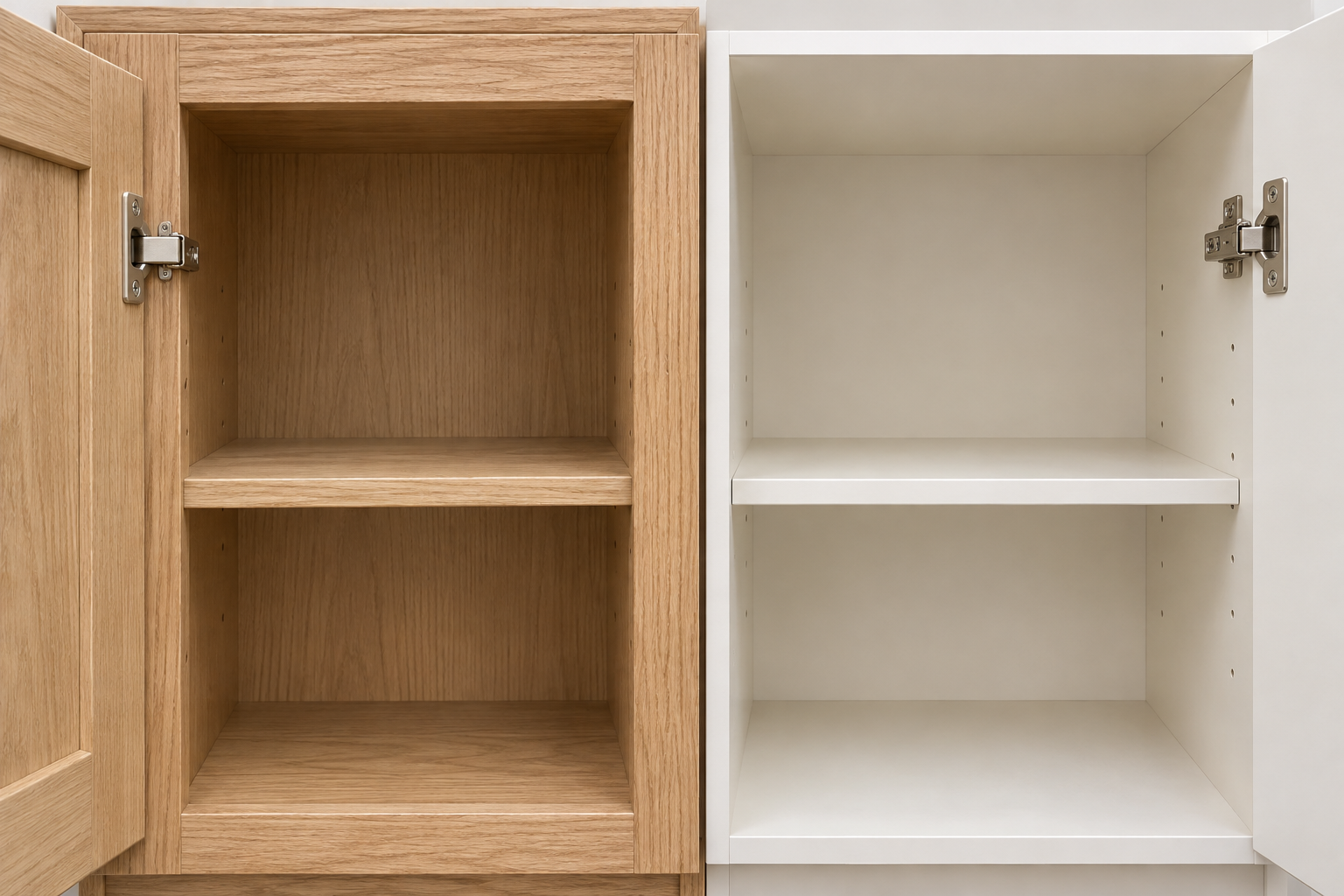
Framed construction (left) places a face frame around the opening; frameless construction (right) mounts the hinge directly to the cabinet side panel.
Door style is a separate decision. A Shaker door can be used on either box, and a flat slab door does not prove that a cabinet is frameless. Once you can identify the box construction, the next question is whether the extra access will actually matter in daily use.
More Access Does Not Always Mean More Storage
The useful frameless advantage is usually a wider clear opening and potentially a wider drawer—not a universal percentage increase in cabinet volume.
Take an illustrative 30-inch cabinet. Two 1½-inch face-frame stiles would leave roughly a 27-inch opening before accounting for other construction details. A frameless box with two ¾-inch sides would leave roughly 28½ inches. In this example, the difference is about 1½ inches, not a fixed percentage that applies to every cabinet.
That extra width can be valuable in a narrow drawer cabinet. In a wide cabinet, the same absolute difference represents a much smaller percentage. Shelf area may not increase at all, because panel thickness and internal fittings also affect usable space.
Access is only one part of the decision. In many kitchens, the door front you want will narrow the construction choices much faster.
Your Door Choice May Narrow the Options
Framed construction supports partial overlay, full overlay, and true inset doors. Inset doors sit within the face frame, creating a flush front but requiring precise fitting.
Standard frameless construction normally uses full-overlay doors that cover nearly all of the cabinet front. A decorative applied frame can create an in-frame appearance, but that is not the same as a true inset door fitted into a structural face frame.
If inset cabinetry is a firm design requirement, framed construction is usually the more direct starting point. If you want a clean full-overlay front, either system may work. At that point, stop choosing by appearance alone and compare the cabinet box, hardware, and installation requirements.
Wall Conditions Matter More Than the “Stronger Cabinet” Myth
A face frame can reinforce the front of a cabinet, but it does not make every framed cabinet stronger. Removing the frame does not automatically make a frameless cabinet weak either.
Panel material and thickness, back construction, joinery, shelf supports, fasteners, and installation all affect rigidity. A well-built frameless box can outperform a poorly built framed box, and the reverse is also true.
The more practical difference is how each system handles real site conditions. Few kitchens have perfectly flat walls and perfectly level floors.
With framed cabinets, face frames, scribe allowances, and fillers can help conceal small differences between units and walls. With frameless cabinets, adjacent boxes and full-overlay doors create narrow, continuous reveals. Alignment errors are more likely to appear directly in those gaps.
This does not make frameless installation impossible. It means wall preparation, leveling, clamping, and final door adjustment need a clear scope. Before ordering, confirm who measures the site, who supplies fillers and scribe panels, and who adjusts the doors after delivery.
Once construction and site requirements are clear, the price comparison becomes much more useful.
Compare Quotes by Details, Not Construction Labels
There is no reliable rule that framed or frameless is always cheaper. The quote changes with the complete specification, and two suppliers may not be offering the same cabinet even when the outside dimensions match.
| Cost driver | Why it changes the quote | What to confirm |
|---|---|---|
| Panel specification | Material and thickness affect rigidity, weight, and price | Side, back, bottom, and shelf panels listed separately |
| Edge banding | Frameless front edges remain visible and need a durable finish | Material and thickness on exposed front edges |
| Face-frame work | Framed cabinets require frame machining, joining, sanding, and finishing | Frame material and how it is joined to the box |
| Hardware | Hinge mounting and drawer requirements differ by construction | Brand, series, model, and mounting type |
| Finished ends and fillers | Exposed sides and uneven walls may require additional panels | Finished ends, scribe pieces, fillers, and toe kicks included |
| Packaging | Visible edges and precise door gaps need protection during shipping | Edge protection and the damage-remedy process |
Before comparing the totals, put both offers on the same specification:
- Framed or frameless construction stated explicitly
- Outside dimensions and clear opening dimensions
- Panel material and thickness for each cabinet component
- Front-edge banding material and thickness
- Door overlay and target reveal between doors
- Hardware brand, series, and mounting type
- Finished ends, fillers, scribe pieces, and installation accessories
- Approved shop-drawing version and inspection reference
If either quote leaves these lines unclear, the lower total may simply represent a different cabinet. Our cabinet quotation guide covers the other line items worth checking.
Which One Fits Your Kitchen?
By this point, the choice usually comes down to a few practical conditions rather than a general preference for American or European style.
- Choose framed for true inset doors, traditional detailing, or sites where face-frame scribing will help manage uneven conditions.
- Choose frameless for full-overlay fronts, wider clear openings, and interiors with fewer front obstructions.
- Compare both when durability or price is the main concern. Those outcomes depend on the full specification, not only the construction type.
- Do not decide from a closed showroom door. Look inside the cabinet, check the hinge mounting and panel edges, and ask for the shop drawing.
Compare Both Constructions on Your Cabinet List
Send your floor plan or cabinet schedule. YoloDeco can review the specification and prepare a framed or frameless option with panel, edge-banding, hardware, and accessory details listed clearly.
WhatsApp UsFAQ
Do frameless cabinets always provide more storage?
No. They often provide a wider clear opening and can allow wider drawers, but the benefit depends on cabinet width, panel thickness, hinges, and drawer fittings. Compare internal dimensions rather than assuming a fixed percentage.
Are frameless cabinets weaker than framed cabinets?
Not necessarily. Strength depends on panel material and thickness, back construction, joinery, fasteners, and installation. A face frame is only one part of the structural picture.
Can frameless cabinets have inset doors?
Standard frameless systems normally use full-overlay doors. A true inset door requires a surrounding frame. Decorative applied frames can create a similar appearance but are a different construction.
Are frameless cabinets more expensive?
Not always. Panel specification, edge banding, machining, hardware, door overlay, and finishing all influence price. Inset framed cabinetry can also be demanding to produce and fit.
Can Shaker doors be used on frameless cabinets?
Yes. Shaker describes the door construction and appearance. Framed and frameless describe the cabinet box. The two choices can be combined.