How to Audit a Kitchen Cabinet Factory in China: A Buyer's Verification Checklist
Quick answer: You don't need to trust any factory — you need to verify four things, in four levels: that the factory exists at the claimed scale (a live video call, free), that its certifications are real (five free public databases), that quality is controlled during production (cabinet-specific floor checks), and that your specific order is protected in writing (specs, QC photos, packing report). The first three levels cost nothing but an hour of your time. A third-party audit (from roughly USD 268 per man-day) covers what you can't check remotely.
This guide is for: importers, wholesalers, contractors, developers, and designers evaluating a Chinese cabinet manufacturer — and homeowners who want to check the factory behind their custom kitchen.
Not for: buyers of stock, off-the-shelf cabinets where factory capability is not the deciding factor.
What Actually Goes Wrong: Four Failure Points
Whether you're importing containers or remodeling one kitchen, a cabinet order from China can only go wrong in four places. Every verification step in this guide exists to close one of them:
| Failure Point | What It Looks Like | Closed By |
|---|---|---|
| The "factory" isn't a factory | A trading company with a nice website takes your deposit and outsources to the cheapest workshop | Level 1: live video verification |
| Certifications are bought, expired, or borrowed | Logos on the homepage; documents that belong to another company or lapsed two years ago | Level 2: public database checks |
| Quality drifts between batches | The approved sample is beautiful; the container that arrives is not the same product | Level 3: production-floor checks |
| Good cabinets, destroyed in transit | Weak cartons, no corner protection, no recourse when parts arrive damaged | Level 4: written order protection |
If a supplier survives all four levels, the remaining risk is normal trade risk — lead times, freight rates, installation. What you're buying with this process is the removal of avoidable surprises.
Level 1 — Existence and Scale: Verify by Live Video Call (10 Minutes, Free)
The first filter is physical reality. A real cabinet factory has a production floor with cutting, edge banding, drilling, finishing, and assembly areas, a raw-material warehouse, and a finished-goods area. A trading company posing as a factory has an office and a showroom at most.
You don't need a plane ticket for this. Ask for a live video call walk-through — not a polished marketing video, but a real-time call where you direct the camera: "Show me the edge banding line. Walk to the finishing booth. Pan across the warehouse." A factory that operates what it claims will schedule this without hesitation, because it costs them nothing. Many established factories — George Group included — run video calls for exactly this purpose: you can walk our production lines and the 30,000 m² showroom live from your desk, and ask for any camera angle you want. If a supplier can only offer a pre-recorded video, ask why.
Scale claims should be concrete and checkable. "100,000 m² production base" is a claim you can test on camera — the floor, the lines, and the material stock either match that footprint or they don't. Vague phrases like "large-scale modern facility" are not testable claims.
Cabinet production lines inside the George Group production base (100,000 m², 9 building-material categories) — the same floor you'd walk on a video callLevel 2 — Certifications You Can Check Yourself Tonight (Free)
This is the level most buyers skip, and where the most inflated claims hide. The rule: don't trust the logo — trust the database. Every certification a cabinet factory commonly claims is independently verifiable in a free public registry run by the issuer itself:
| Claim to Verify | Ask the Factory For | Where You Check It |
|---|---|---|
| FSC-certified wood sources | FSC license code (format FSC-C######) or exact legal company name | FSC public certificate database — confirm the scope covers the products you buy and the certificate is valid, not expired |
| GREENGUARD / GREENGUARD Gold finishes | Exact certified product name and UL certificate reference | UL SPOT database, which lists more than 180,000 product families — confirm the listing is active, the model matches, and whether the level is GREENGUARD or GREENGUARD Gold |
| CARB Phase 2 / TSCA Title VI board compliance | Certificate naming the third-party certifier (TPC) that issued it | EPA's recognized TPC list and CARB's approved TPC list (both include China-based certifiers such as SGS China, TÜV Rheinland China, and Intertek) — then confirm the factory's status with that TPC |
| ISO 9001 / ISO 14001 | Certificate number and issuing body | IAF CertSearch globally; for China-issued certificates, the CNCA public platform shows whether a certificate is valid, suspended, or withdrawn |
Three details make this level work:
- Match the legal entity. The certificate holder name must match the company you are paying — not a parent, a "group," or an unrelated factory down the road.
- Check the scope. An FSC certificate for trading is not an FSC certificate for manufacturing the product you are buying. A GREENGUARD listing for one sealer is not a GREENGUARD-certified cabinet line. Scope and product family are printed in the database entry.
- Check the status, not just the existence. EPA maintains a separate list of suspended and revoked third-party certifiers precisely because paper claims get abused. A certificate issued by a suspended TPC is a red flag, not an asset.
For cabinets sold into the US, TSCA Title VI deserves special attention: since March 22, 2019, composite wood products — including finished goods containing hardwood plywood, MDF, or particleboard, which means cabinets — must be certified compliant to enter the country. The regulation (40 CFR Part 770) is still evolving; EPA issued a proposed update in February 2026. If your supplier can't name the TPC behind their compliance claim, that order carries customs risk, not just quality risk.
You can see this database method applied to ten real brands in our eco-friendly cabinet brands certification comparison — every certificate in it was checked in the same registries listed above.
Level 3 — The Production Floor: Where Quality Is Made or Lost
A certificate says a factory met a standard once. Process discipline is what makes container #20 match the approved sample. This level is where professional buyers — importers, contractors, developers — should spend the most time, and it works on a live video call almost as well as in person. Five checkpoints:
1. Incoming materials: paperwork and batch traceability
Board compliance can't be judged by looking at a panel — you verify it through the CARB/TSCA documentation from Level 2, plus batch traceability from board supplier to production order. Ask: "If a panel in my order has a problem, can you trace which board batch it came from?" A trading company can't answer that. What you can see on camera is how boards are stored: flat, off the floor, indoors, away from moisture. Warped or edge-swollen stock in the warehouse predicts panel problems better than any brochure.
2. Edge banding
Edge banding is where cheap cabinets announce themselves. Look at finished panels up close: the band should sit flush with no glue line, no overhang, trimmed corners. Ask what adhesive and banding material the line runs, and watch one panel go through the machine on the video call — an operating line is harder to stage than a sample board.
3. The finishing line
Ask to see where panels are actually painted or coated: a dedicated spray booth with dust control, curing space, and a sanding/preparation area. Then check a cured door: consistent sheen, no dust nibs, no rough back side. A factory that outsources finishing loses control of exactly the surface your customer touches every day.
4. Hardware brands, in writing
Hinges and drawer slides decide how the kitchen feels after five years. A serious factory names the hardware brands and series in its quotation — and shows you bins of that hardware on the floor. If the quote says "soft-close hinges" with no brand, expect the cheapest option to arrive.
5. QC checkpoints during production, not just at the end
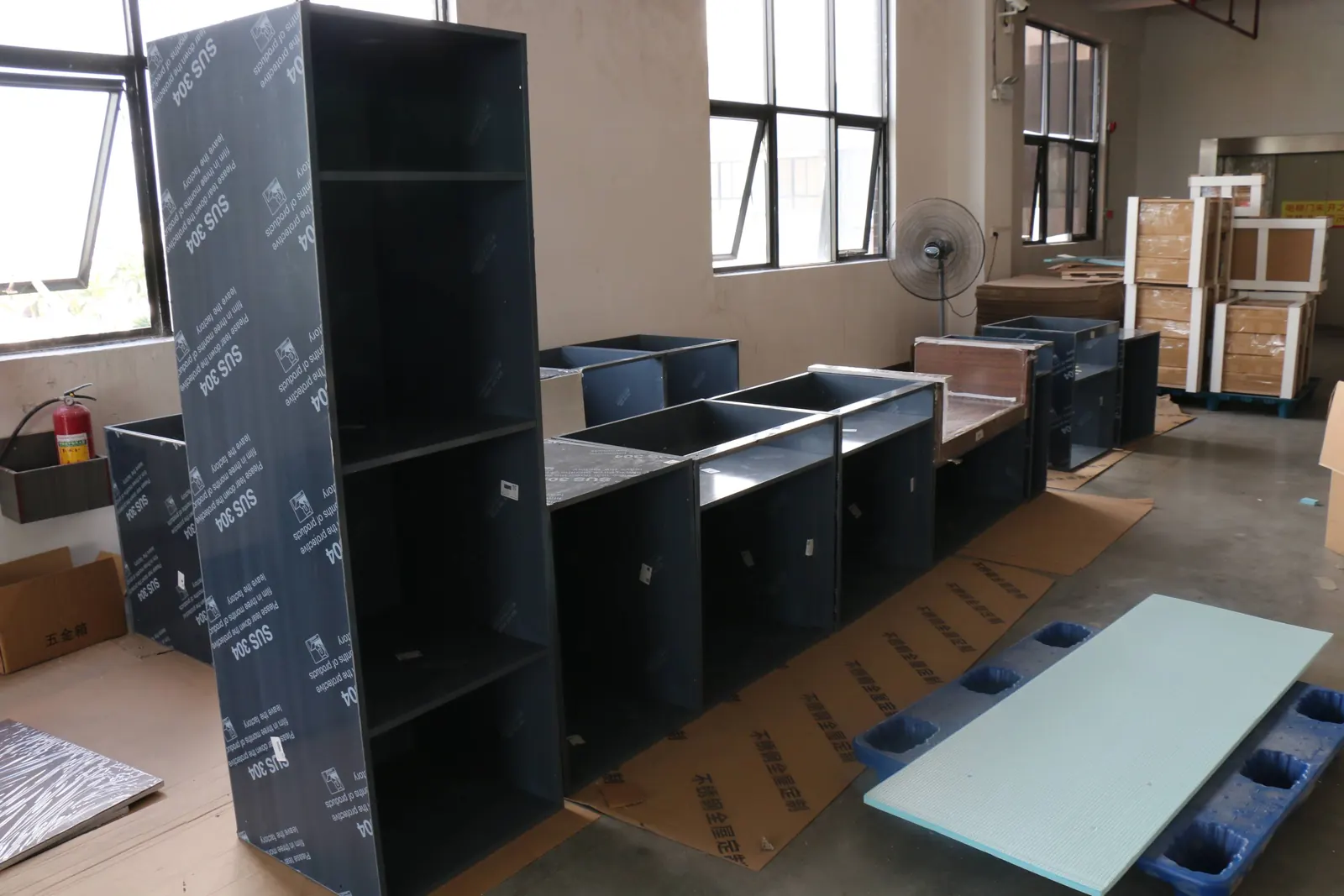
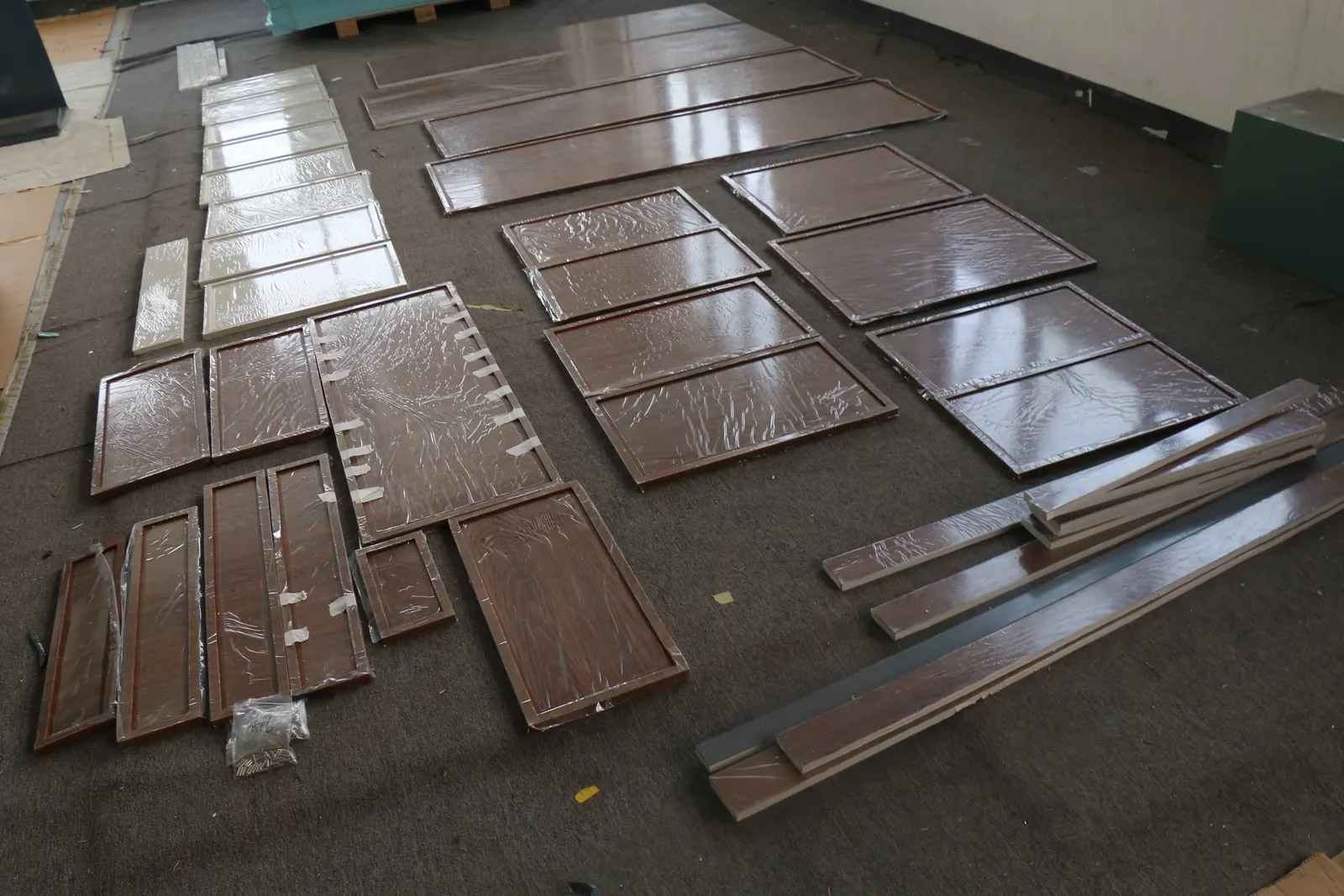
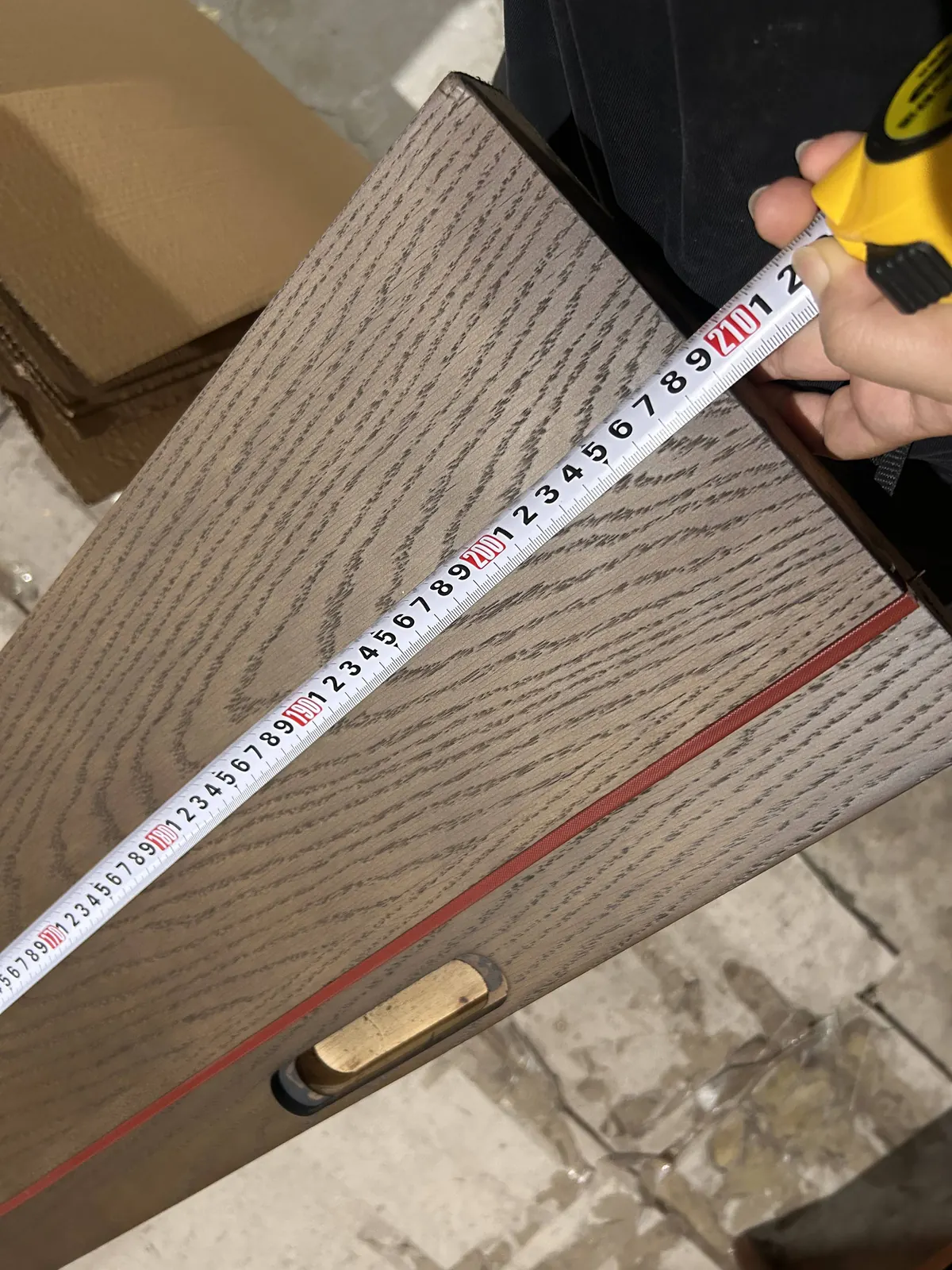
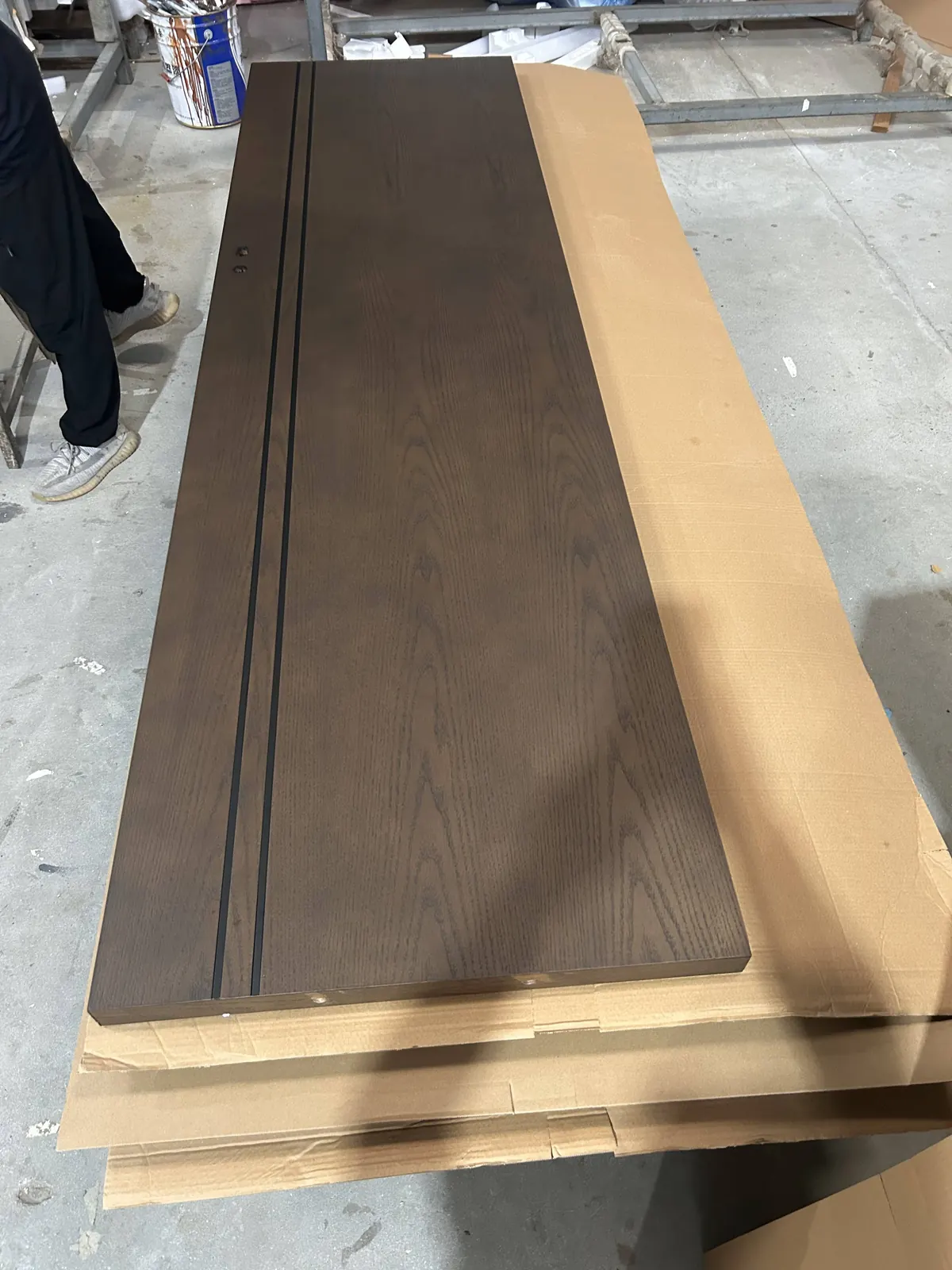
Quality inspected at the end catches defects; quality checked at each stage prevents them. Ask where the QC checkpoints sit in the process — after cutting, after banding, after finishing, before packing — and what gets recorded at each. This is what those checkpoints look like on a real floor, from George Group's own QC process in Foshan:
A performance yardstick you can borrow: KCMA A161.1
Even if you never require the certification, North America's KCMA standard (ANSI/KCMA A161.1) is a useful question list. It puts cabinets through 14 tests — including a 600-lb load test — simulating a lifetime of use, and KCMA reports that 40–50% of cabinets fail on first submission. Few Chinese export factories hold KCMA certification, so don't demand the logo. Instead, ask your factory which of those test items its construction would survive — shelf load, drawer cycle, door impact, finish resistance — and watch how specific or evasive the answer is. A factory with real process discipline answers in test items; a trader answers in adjectives.
Level 4 — Your Specific Order: Paper Before Production
Levels 1–3 tell you the factory is capable. This level protects your order. Everything that defines your cabinets should exist in writing before production starts, and everything that proves they were built right should exist before the container is sealed:
- 3D design and shop drawings, approved by you before production. A serious manufacturer prepares a custom cabinet design from your floor plan, then technical drawings with every cabinet and panel numbered — that is what the factory builds and what you measure the delivery against.
- Material and hardware schedule in the quotation. Board type, finish system, hinge and slide brands and series — all named, so nothing can be silently downgraded.
- Pre-shipment QC and packing report with photos. Your inspection without flying to China: finished goods checked against the drawings, then photographed before crating.
- Written packing spec. Corner protection, moisture barriers, crating or reinforced cartons matched to product weight; furniture and cabinet shippers commonly validate packing with ISTA-series test procedures (drop and vibration simulation). Plus container loading photos on shipping day.
- Replacement-parts policy with a response time, written into the order confirmation — not a verbal promise.
This is also where you find out whether the factory's Level 3 discipline is real: a manufacturer with genuine process control already produces these documents as part of normal operations. If providing them feels like a special favor, that tells you something.
Do It Yourself or Hire a Third-Party Auditor?
Levels 1–4 are free except your time. Bring in a third-party inspection company when the order value justifies it, when you can't get straight answers remotely, or when you want an independent pre-shipment inspection on a first order. What it costs:
| Provider | Public Pricing (China) | Notes |
|---|---|---|
| V-Trust | From USD 268 per man-day, all-inclusive (travel, weekends, 24-hour report) | Publishes flat day rates on its website |
| QIMA | Publishes country-specific day rates on its pricing page; third-party comparisons put China at roughly USD 300+ per man-day | Flat-day-rate model, quote within 24 hours |
| SGS, Bureau Veritas, TÜV, Pro QC | No public day rates — quote only | Budget more time for the quotation process |
Across industry comparisons, third-party inspection day rates in China typically fall in the USD 150–400 range per man-day depending on region and scope (figures above: provider websites and industry comparisons, accessed September 2026 — confirm current pricing before budgeting).
But before paying anyone, check what the factory already hands you. A manufacturer with genuine process control documents its own output as standard practice. George Group orders, for example, ship with a pre-shipment inspection package — photos, video of the finished goods, and a written report checked against your approved shop drawings before crating — so for many orders the inspection evidence already exists at no extra cost. What a third party still adds on top of that is independence: an inspector who doesn't work for the factory. So the practical rule is: if the supplier provides full inspection documentation, use it and spot-check it (do the photos show your order number, your drawings, today's date?); reserve the paid third-party audit for a first container with a supplier whose documentation is thin, or for the day their own reports stop answering your questions.
Run This Checklist on Us: How George Group Closes All Four Failure Points
We wrote this checklist because buyers ask us these questions every week — and we answer them with the same evidence we recommend you demand from anyone, us included. No honest factory can promise that problems are impossible; what you should demand is that every failure point has a mechanism that prevents it and a paper trail that proves it. Here is how each of the four is closed at George Group, a Foshan-based custom manufacturer (founded 2006) serving homeowners, contractors, developers, designers, importers, and wholesalers:
| Failure Point | How It's Closed at George Group | How You Verify It Yourself |
|---|---|---|
| The "factory" isn't a factory | 100,000 m² production base covering 9 building-material categories (cabinets included) and a 30,000 m² showroom in Foshan, both open for visits — and we run live video calls where you direct the camera yourself, line by line | Book a video call and walk the floor from your desk; the factory video above is the same floor |
| Certifications are bought, expired, or borrowed | FSC-certified wood sources, CARB2/TSCA-compliant boards, GREENGUARD Gold certified finishes — documents issued to our legal entity, available on request | Take the certificate numbers and check them in the Level 2 databases before you sign anything |
| Quality drifts between batches | QC checkpoints at each production stage — after cutting, banding, finishing, and before packing — with the photo documentation you saw above produced as standard practice, against your approved shop drawings | Ask for the checkpoint photos and records on your order, not a sample from stock |
| Good cabinets, destroyed in transit | Written packing spec, pre-shipment inspection package (photos, video, and written report), container loading photos, and a replacement-parts policy with a response time in the order confirmation | These documents are standard in every George Group order — ask for them in yours |
Beyond cabinets, the Foshan showroom covers 9 building-material categories — wardrobes, doors and windows, stone, sanitary ware and more — so project buyers can consolidate into one shipment. See the scale yourself:
George Group showroom tour (30,000 m², 3,000+ samples, Foshan)If you're still deciding whether buying from China fits your project at all, start with our guide to buying kitchen cabinets from China — design service, safeguards, and what you actually receive, and the custom cabinet cost breakdown for budgeting.
Red Flags That End the Audit Early
- Hesitation on a live video call. A real factory walks you through it the same week (Level 1). Delays, rescheduling, or "we only have a marketing video" usually means you're talking to a trading company.
- Certificates without numbers. Logos on a website are marketing. No license code, no certificate number, no verifiable claim (Level 2).
- Entity mismatch. The certificate belongs to a different company name than the one on your quotation or bank account (Level 2).
- Suspended certifiers. The TPC behind a CARB/TSCA claim appears on EPA's suspended or revoked list (Level 2).
- Answers in adjectives. "Very good quality, strict QC" instead of named checkpoints, test items, and hardware brands (Level 3).
- No written specs. A quotation without board type, finish system, and hardware brands is a quotation you can't hold anyone to (Level 4).
Methodology and Sources
Verification procedures and database details: FSC certificate database guidance and public search; UL SPOT product database; US EPA formaldehyde emission standards for composite wood products, TSCA Title VI, 40 CFR Part 770, including the recognized and suspended/revoked third-party certifier lists and the February 2026 proposed rule update; CARB-approved third-party certifier list; KCMA certification program and ANSI/KCMA A161.1 test information, including the 40–50% first-submission failure figure from KCMA's published materials; IAF CertSearch and China CNCA public certification platform. Third-party pricing: V-Trust published service pricing, QIMA pricing page, and industry comparisons, accessed September 2026. George Group factory, showroom, certification, and project figures are internal company records consistent with our published company information. This guide reflects our own audit and QC practice as a manufacturer; it is a verification framework, not a substitute for legal or customs advice on your specific order.
FAQ
Want to run this checklist on us first? Book a live video call — walk the George Group factory floor and showroom from your desk, and direct the camera yourself. Or send your floor plan for a free 3D design and itemized quotation. We'd rather be audited than admired.